Since 1909
A short history of Athol
Until the early 1800s, when explorers/trappers began coming into the area, Native American tribes, primarily of the Coeur d’Alene and Spokane Tribes, had exclusive use of the land as they migrated through the region en route to their encampments near the area's many lakes and streams.
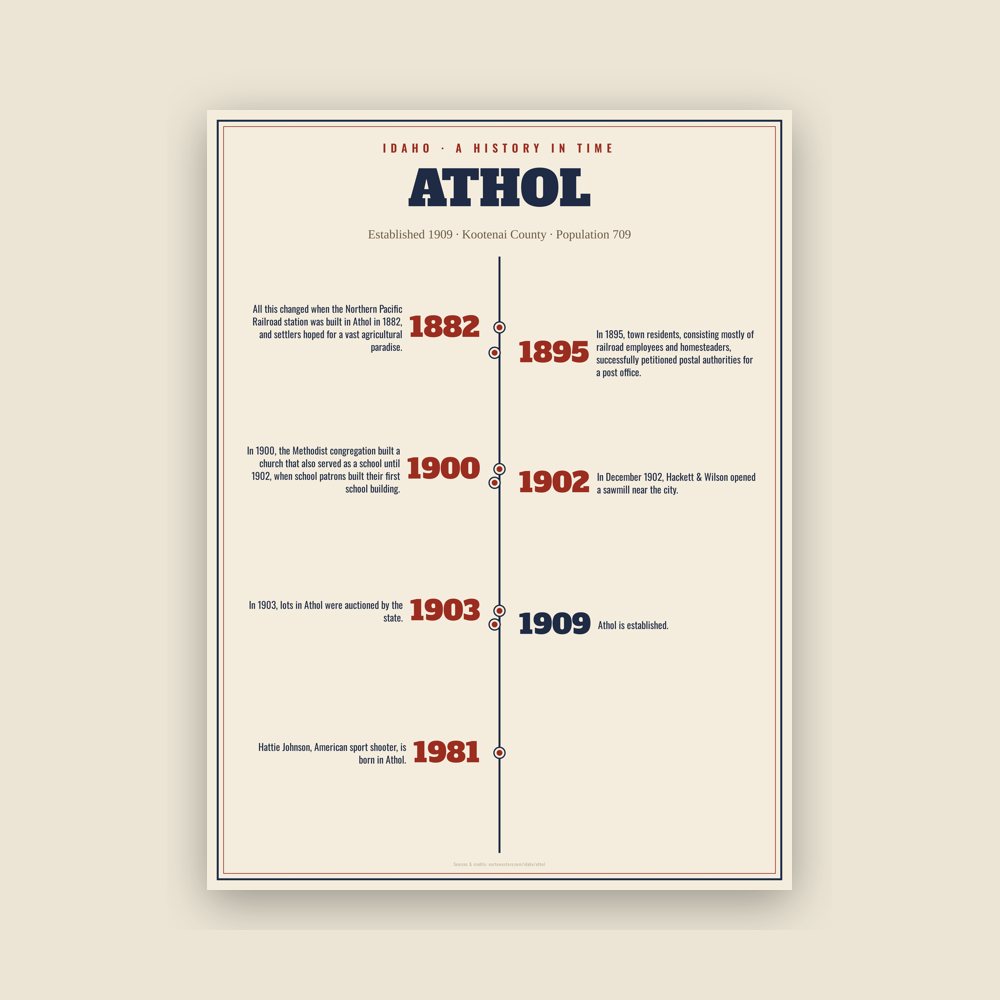
All this changed when the Northern Pacific Railroad station was built in Athol in 1882, and settlers hoped for a vast agricultural paradise. The depot was established in Athol on its line between Hauser Junction and Sandpoint. In 1895, town residents, consisting mostly of railroad employees and homesteaders, successfully petitioned postal authorities for a post office.
The white pine forest first attracted early settlers to Athol, and logging, milling, and agriculture created prosperity. However, the location of the new community was on state lands. In 1903, lots in Athol were auctioned by the state. State surveyors platted the new township, but apparently did not record the change in ownership. For many years, the town's residents did not have title to their land. Eventually, the state corrected the problem.
Athol was first known as Colton; the town was renamed Athol by a settler who came from Athol, Massachusetts, which was named after a town in Scotland named for the Duke of Atholl. No one knows for sure if Athol, Idaho, was named by a descendant of the same family or if the name was just brought west during the 19th century.
In 1900, the Methodist congregation built a church that also served as a school until 1902, when school patrons built their first school building. In December 1902, Hackett & Wilson opened a sawmill near the city. The mill became the city's largest employer and had the capacity to produce 25,000 board feet of lumber per day. By 1903, there were many businesses open, including the Pacific Hotel, a drugstore, a smithy, a jewelry store, restaurants, a mercantile company, and a saloon.
Athol's first water well was dug by hand by Joe Pricsha and his crew. It was over 350 feet deep. They dug into a large boulder, so they had to dig around it, which made a curve in the shaft. A 5 hp pump motor was installed, which supplied the town with water. Later, another shaft with a larger pump was installed in the same hand-dug hole.
Adapted (trimmed) from the Wikipedia article Athol, Idaho, revision 1378480332 by its contributors, licensed CC BY-SA 4.0.