A short history of St. Cloud
During the 1870s, Hamilton Disston of Philadelphia took an interest in developing the region while on fishing trips with Henry Shelton Sanford, founder of the city of Sanford. Disston contracted with the Florida Internal Improvement Fund, then in receivership, to pay $1 million to offset its Civil War and Reconstruction debt. In exchange, Disston was awarded half the land he drained from the state's swamps. He dug canals and, in 1886–1887, established St. Cloud sugarcane plantation, named after St. Cloud, Minnesota, although many longtime locals claim the town was named after Saint-Cloud, France.
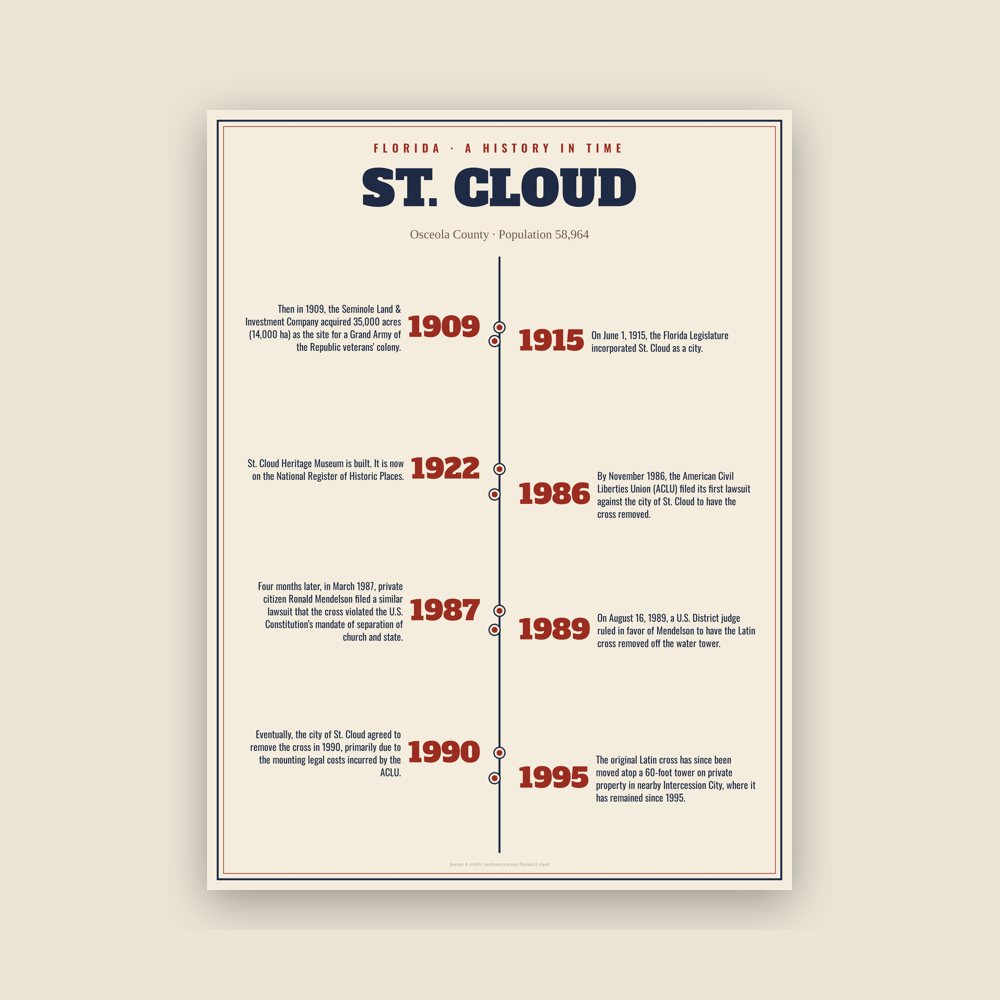
Disston opened the Sugar Belt Railway to the South Florida Railroad in 1888 to carry his product to market. But the Panic of 1893 dropped land values, and the Great Freeze of 1894–1895 ruined the plantation. Disston returned to Philadelphia, where he died in 1896. The Sugar Belt Railway merged into the South Florida Railroad. An attempt to cultivate rice in the area failed, and for several years the land remained fallow. Then in 1909, the Seminole Land & Investment Company acquired 35,000 acres (14,000 ha) as the site for a Grand Army of the Republic veterans' colony. St. Cloud was selected because of its "health, climate and productiveness of soil." It was first permanently settled in 1909 by William G. King, a real estate manager from Alachua County who had been given the responsibility "to plan, locate and develop a town."
On April 16, 1909, the Kissimmee Valley Gazette announced the "New Town of St. Cloud", a "Soldiers Colony" near Kissimmee. The newspaper called the Seminole Land and Investment Company's purchase "one of the most important real estate deals ever made in the State of Florida". It was reported that the company had searched all over Florida for the perfect site for a veterans' colony, particularly one suited for "health, climate, and productiveness of the soil". It is believed that many of the streets were named for states from which the Civil War veterans had served, but the street names were already assigned to the platted land before settlement occurred. Due to the large number of veterans buried in Mt. Peace Cemetery, the latter has been called "one of the largest non-battlefield Union cemeteries south of the Mason–Dixon line".
Early St. Cloud had a history as a Sundown Town with a plot of land outside the city reserved for black residents officially dubbed "Colored Quarter". This name is still active on official land records as the title of this section of land. Early newspaper records support the history of being a "Sundown Town" with firsthand accounts of local residents making attempts "to keep the colored folks in their own quarters outside the town".
On June 1, 1915, the Florida Legislature incorporated St. Cloud as a city. Its downtown features landmark buildings by the Orlando architectural firm Ryan & Roberts, a partnership consisting of two women. The buildings by Ryan and Roberts and others downtown are predominantly Spanish Revival.
St. Cloud has tried to separate itself from neighboring cities, and particularly the theme parks, by promoting an image of small-town life, and by attempting to make itself economically less dependent on Kissimmee. On March 6, 2006, St. Cloud introduced the CyberSpot program, becoming the first city in the United States to give residents free high-speed wireless Internet access, but the program ended in 2009.
Read the full history
Water tower cross controversy
In the late 1960s, the city of St. Cloud was gifted a Latin cross during the Christmas season. The twelve-foot tall cross, which was illuminated at night, stood atop the city’s water tower off U.S. Route 192 for nearly twenty years without issue.
By November 1986, the American Civil Liberties Union (ACLU) filed its first lawsuit against the city of St. Cloud to have the cross removed. Four months later, in March 1987, private citizen Ronald Mendelson filed a similar lawsuit that the cross violated the U.S. Constitution’s mandate of separation of church and state. Mendelson, a Jewish resident who lived east of St. Cloud, decided to sue because of the city’s implicit endorsement of Christianity atop the water tower and the inconvenience Mendelson felt due to the "shadow of the cross". In defense of its presence, residents cited the cross as a local landmark and directional marker for boaters, drivers, and pilots commuting within St. Cloud.
On August 16, 1989, a U.S. District judge ruled in favor of Mendelson to have the Latin cross removed off the water tower. The judge, however, suggested in his ruling that the city replace the Latin cross with a Greek cross, distinguished for representing a plus-sign, to identify St. Cloud as a crossroad city. The ACLU quickly filed an additional lawsuit, claiming that the new Greek cross still violated the U.S. Constitution in an attempt to evade the judge's original ruling.
Eventually, the city of St. Cloud agreed to remove the cross in 1990, primarily due to the mounting legal costs incurred by the ACLU. Local support through the city council to reinstate the Latin cross on private property within St. Cloud was proposed. Ultimately, those discussions fell through due to the 35-foot height restriction that the cross would have exceeded on a structure within city limits.
The original Latin cross has since been moved atop a 60-foot tower on private property in nearby Intercession City, where it has remained since 1995.
Adapted (trimmed) from the Wikipedia article St. Cloud, Florida, revision 1376378613 by its contributors, licensed CC BY-SA 4.0.