A short history of Scottsboro
Early history
Prior to Scottsboro's founding, the area surrounding the present-day city was inhabited by the Cherokee Indians. While the Tennessee Valley did not have large Native American settlements at the time of the first white settlers, there was a Cherokee town named "Sauta" near where Scottsboro developed along the Tennessee River.
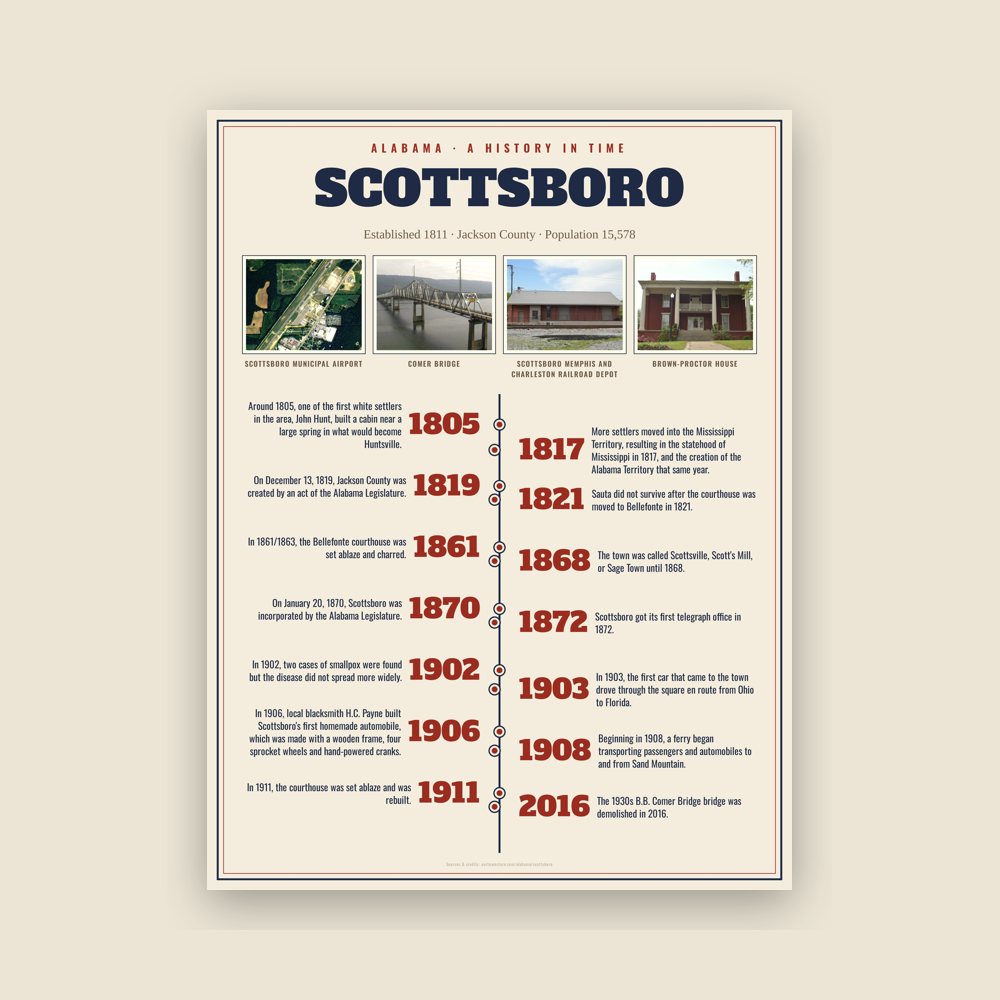
As settlers began pouring into the eastern Tennessee region, chiefly from the Upper South, they found the Tennessee River to be an excellent source of food, water, transportation and trade. Around 1805, one of the first white settlers in the area, John Hunt, built a cabin near a large spring in what would become Huntsville. The town was formally incorporated in 1811. Huntsville (Madison County's seat, later the Alabama state capital and today the state's largest city) would be home to the Mississippi Territory land office where much of Jackson County would be partitioned and sold after the Cherokee ceded their lands.
More settlers moved into the Mississippi Territory, resulting in the statehood of Mississippi in 1817, and the creation of the Alabama Territory that same year. On December 13, 1819, Jackson County was created by an act of the Alabama Legislature. One day later, the State of Alabama was admitted into the Union as the 22nd state on December 14, 1819.
The first county seat of Jackson County was at Sauta, a former native town, near present-day Scottsboro. Early county meetings were held in Sauta cave. Sauta did not survive after the courthouse was moved to Bellefonte in 1821.
Since Bellefonte had better access to the Tennessee River than Sauta, more settlers started moving to the area. They were also attracted by it being the county seat.
Scottsboro's founder, Robert Thomas Scott, served in the Alabama Legislature for almost 20 years and later ran a hotel in Bellefonte.
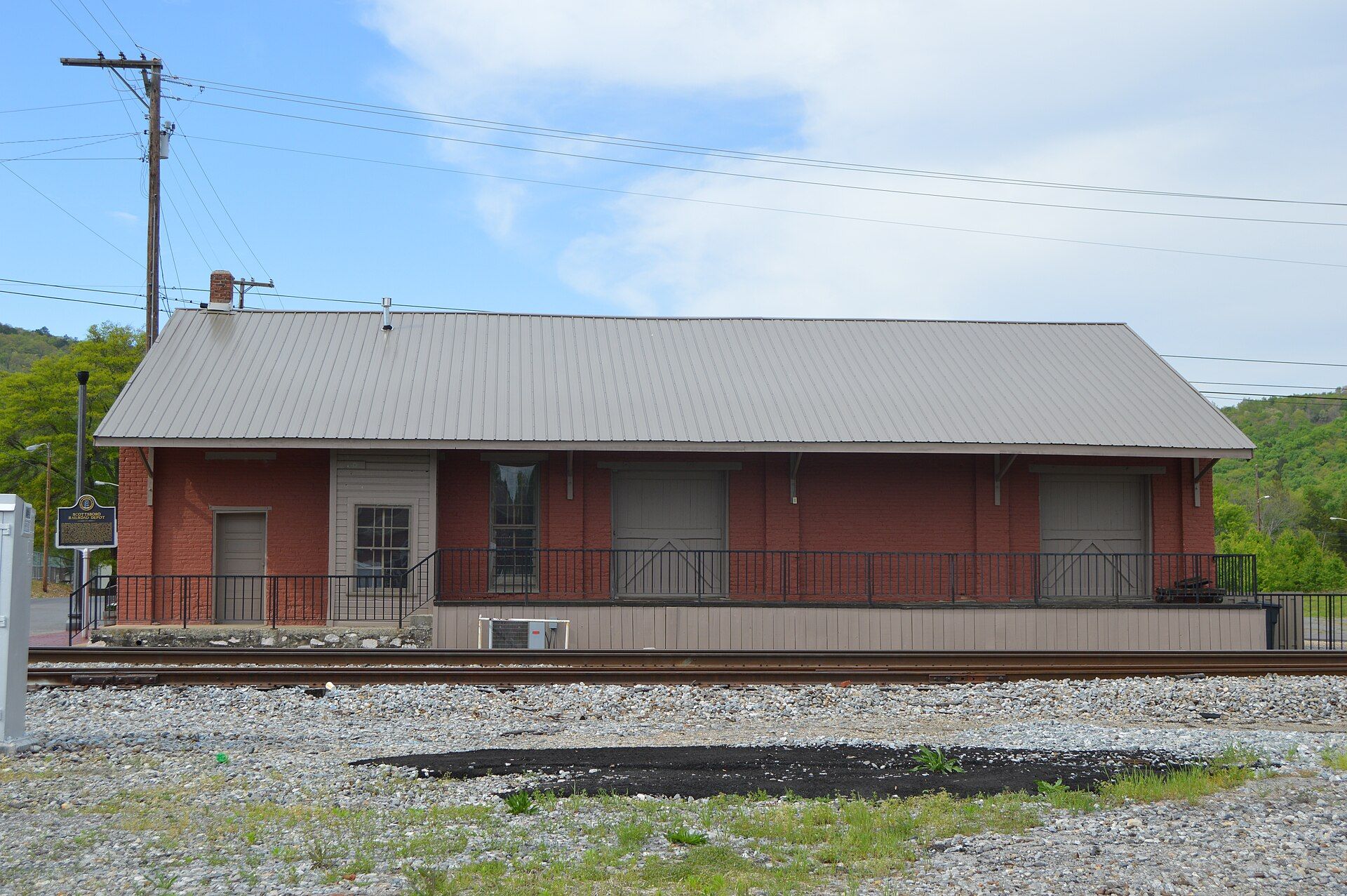
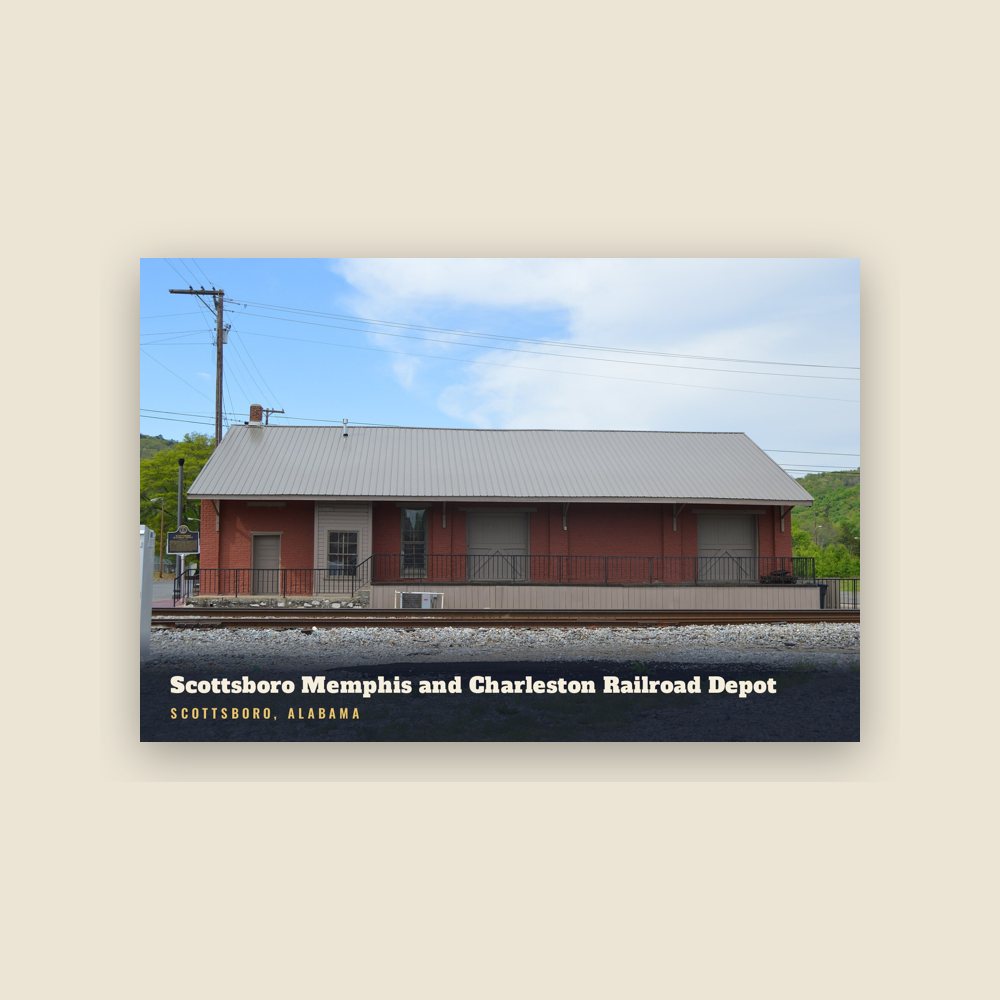
Since he and his wife, Elizabeth, wanted a place to call their own and were not very fond of Bellefonte, they moved to what would become Scottsboro around 1850–53. The town was called Scottsville, Scott's Mill, or Sage Town until 1868. In 1853, the newly formed Memphis and Charleston Railroad, which ran from Memphis, Tennessee, to Stevenson, Alabama (with connections to Charleston, South Carolina), decided to build a station at Scottsboro and did so in 1857. In the same year, the M&C railroad initiated passenger service at Scott's Station.
Bellefonte citizens rejected the railroad because they did not want train travel to interfere with the town's thriving river trade. In addition, its low riverside land was not suitable for tracks.
In 1861/1863, the Bellefonte courthouse was set ablaze and charred. The area was heavily damaged during the U.S. Civil War.
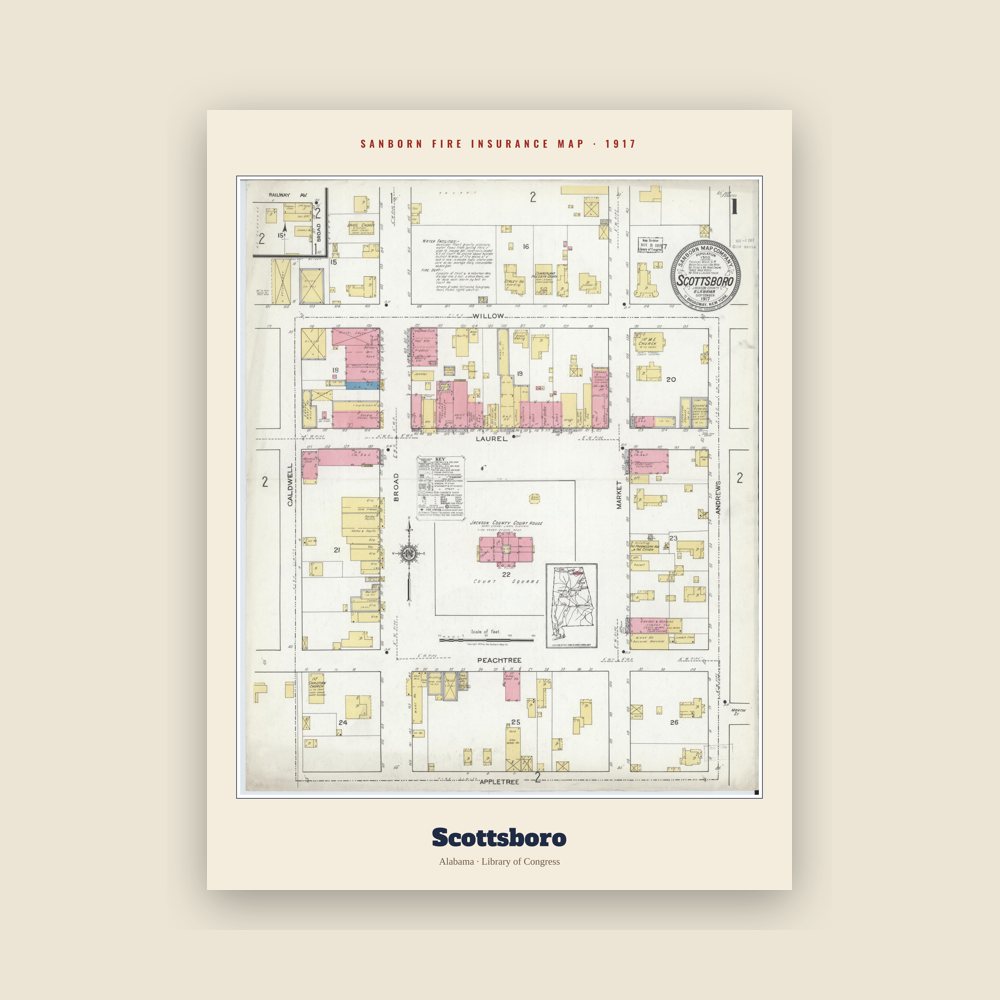
The second requirement eliminated Stevenson and Larkinsville, and the county commissioners ultimately selected Scottsboro as the county seat. This led to the rapid decline of Bellefonte, which also suffered from no railroad access. Courthouse construction began in 1868 with the jail following two years later. County commissioners sited the courthouse at its current location in the public square.
On January 20, 1870, Scottsboro was incorporated by the Alabama Legislature. A. Snodgrass was the first mayor. Scottsboro got its first telegraph office in 1872.
The 20th century brought great changes to Scottsboro. In 1902, two cases of smallpox were found but the disease did not spread more widely. In 1903, the first car that came to the town drove through the square en route from Ohio to Florida. In 1906, local blacksmith H.C. Payne built Scottsboro's first homemade automobile, which was made with a wooden frame, four sprocket wheels and hand-powered cranks. In 1911, the courthouse was set ablaze and was rebuilt. In 1912, the courthouse was demolished and an election was held to determine whether the courthouse would be moved to Stevenson or stay in Scottsboro (some Stevenson residents did not think Scottsboro deserved the role of county seat). Scottsboro won the vote and the present courthouse was built (It was later renovated and expanded in 1954.)
Read the full history
The Scottsboro Boys
The Scottsboro Boys case was among the most important civil rights cases in the history of American jurisprudence. It was twice appealed to the United States Supreme Court and established the principles that, in the United States, criminal defendants are entitled to effective assistance of counsel and that people may not be de facto excluded from juries due to their race.
In 1931 nine black youths, ranging in age from twelve to twenty, were accused of raping two white females, Victoria Price and Ruby Bates (who later recanted her accusation). The two females, several other white males and the accused alike had all hitched rides on a westbound Southern Railway freight train coming from Chattanooga on March 25, 1931. The white males reported to a nearby train master that they had been attacked by a group of blacks and forced off the train. Shortly thereafter, the authorities stopped the train at Paint Rock, Alabama, and arrested the black youths. Bates and Price accused the black youths of rape. The defendants were taken to Scottsboro, the seat of Jackson County.
During the course of four trials, most of the defendants were convicted and sentenced to death by all-white juries, although witnesses provided weak and contradictory testimonies. The case is now widely regarded (including in Scottsboro) as one of the worst travesties of justice perpetrated against blacks in the post-Reconstruction South. Only the first trials were held in Scottsboro. Of the original nine young black defendants (some of them minors at the time of arrest), accused of gang raping two fellow hobo white females on a freight train, eight were quickly convicted and sentenced to death by all-white juries in trials occurring in a mob atmosphere in Scottsboro.
The only two local attorneys who were willing to take the cases had few qualifications for criminal defense work. They were unable to put up much of a defense when the judge gave them no time to prepare their defenses before the trials. He started the first trial as soon as they agreed to take the cases, and then began each case as soon as the jury had gone out on the previous one.
In its two reviews of appeals from the case, the United States Supreme Court overturned their death sentences and convictions, saying that the convictions had been obtained by improper procedures. Those convicted spent at few as six years and as many as nineteen years incarcerated in harsh local jails and state prisons. The Scottsboro Boys had served long prison sentences when Governor George Wallace partially mitigated this widely accepted injustice by issuing a pardon in 1976 for the one remaining Scottsboro defendant still living.
"In January, 2004, amidst television cameras and radio and newspaper reporters, a crowd gathered near the Jackson County Court House in Scottsboro to dedicate a historical marker commemorating the Scottsboro Boys' trial and their struggle for justice." "An 87-year-old black man who attended the ceremony, one of the few who could remember the cases firsthand, recalled that the mob scene following the Boys' arrest 'was frightening' and that death threats were leveled against the jailed suspects. He applauded the town's move to install the plaque on the courthouse yard. 'I think it will bring the races closer together,' he said, 'to understand each other better.'"
Modern history
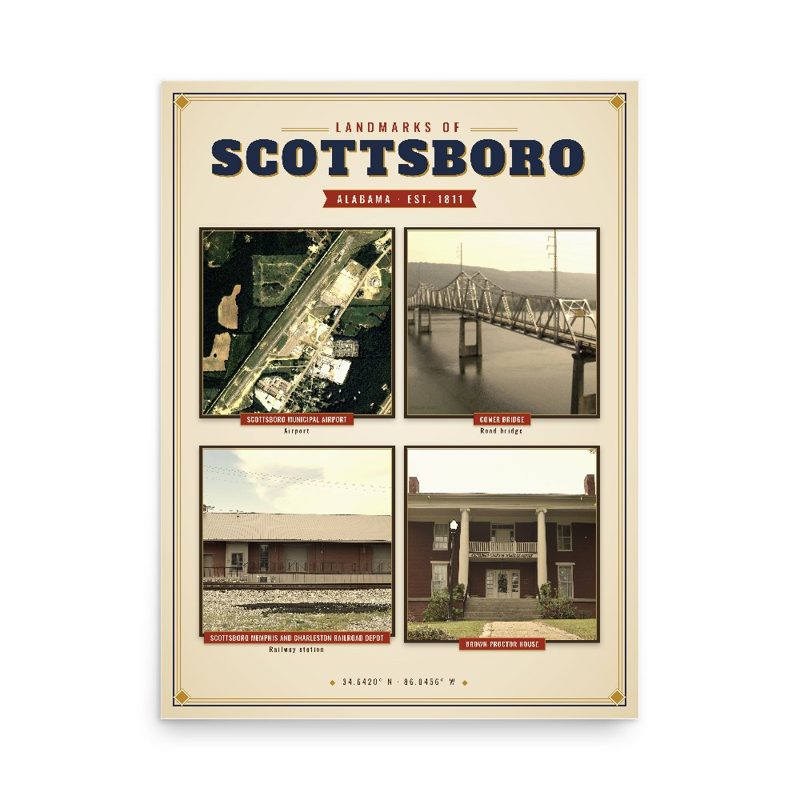
Beginning in 1908, a ferry began transporting passengers and automobiles to and from Sand Mountain. From 1928–1931, the Kansas City Bridge Company built the B. B. Comer Bridge, a 2,143-foot (653 m) long steel bridge that connected the county seat to Sand Mountain, almost tripling the town's population. The bridge entered use in July 1930. By 2007, the aging structure was classified by the Alabama Department of Transportation as being a structurally deficient bridge with an overall rating of 7.7 out of 100. Construction of a replacement bridge commenced in October 2007, and was completed by 2016. In 1932, a couple were wed on top of the bridge. The newlywed wife commented, "I wanted to be married where the light-blue water touches and meets with the light-blue sky…" In the 1980s, a second bridge was built to improve travel and reduce traffic on the old bridge. The 1930s B.B. Comer Bridge bridge was demolished in 2016.
In 1913, the city purchased approximately 30 acres (12 ha) for a water system on Sand Mountain. The first electric lights in Scottsboro became operational on January 21, 1916. Scottsboro's first hospital was established in 1923.
In 1927, aviator Charles Lindbergh performed stunts in his plane The Spirit of St. Louis. In 1932, Scottsboro officially became a "city" when an act of the Alabama Legislature bestowed that title on towns with more than 2,000 inhabitants. Scottsboro's population at the time was about 2,304.
By 1954, the courthouse had started to deteriorate. It was renovated. and all the wooden walls were replaced with marble. Because of the growth in population and demand, more rooms were added to expand offices for services such as automobile tags and land records.
Since the early 1980s to the late 2000s, Scottsboro has seen substantial population growth as the economy moved away from its rural, agrarian past to a more diversified one. Real estate in a small town environment and competitive state business tax rates both appealed to newcomers who bought homes and/or commuted to jobs in Chattanooga, Huntsville and Atlanta.
Adapted (trimmed) from the Wikipedia article Scottsboro, Alabama, revision 1378693224 by its contributors, licensed CC BY-SA 4.0.
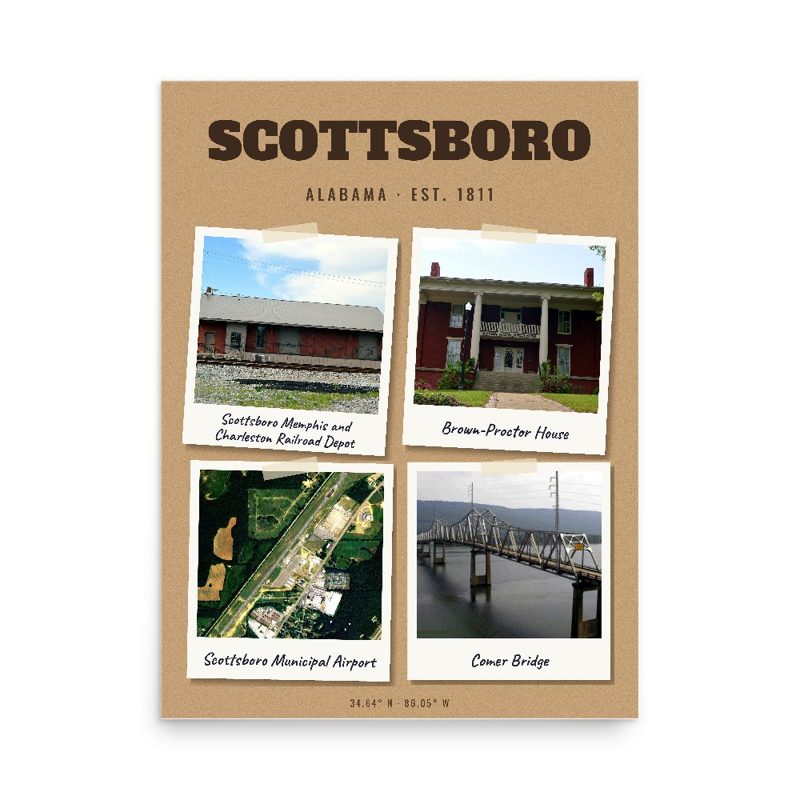
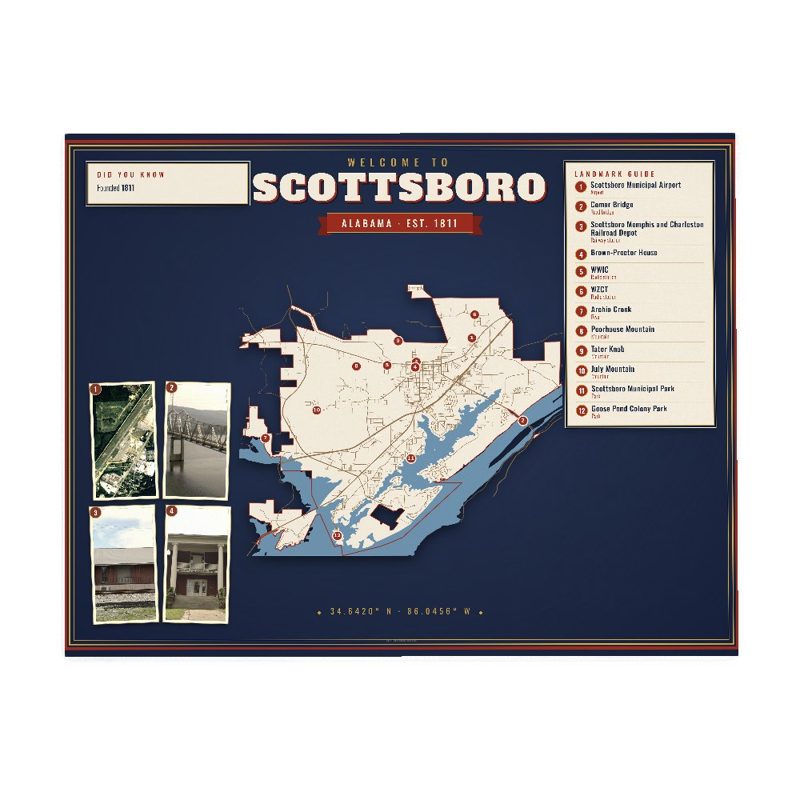













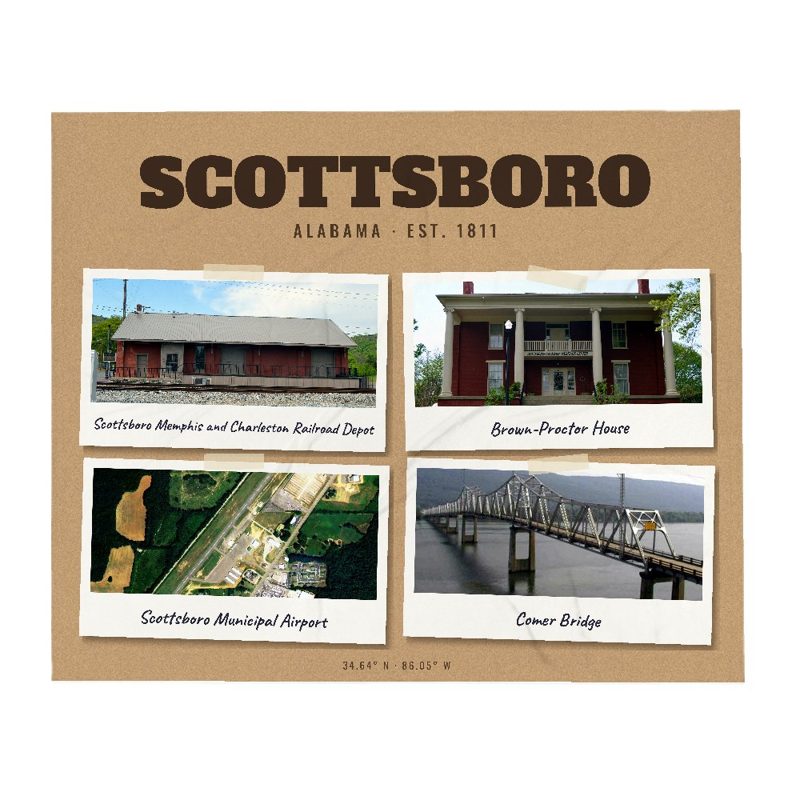

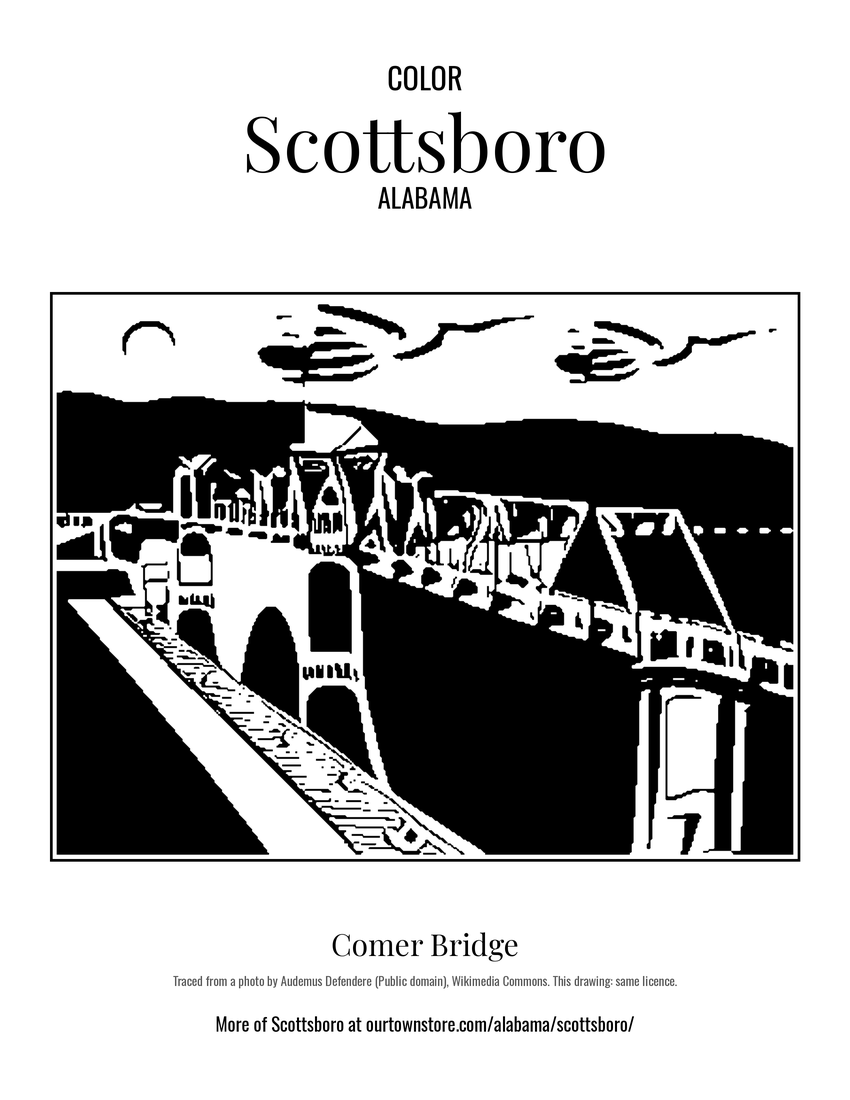 Comer Bridge
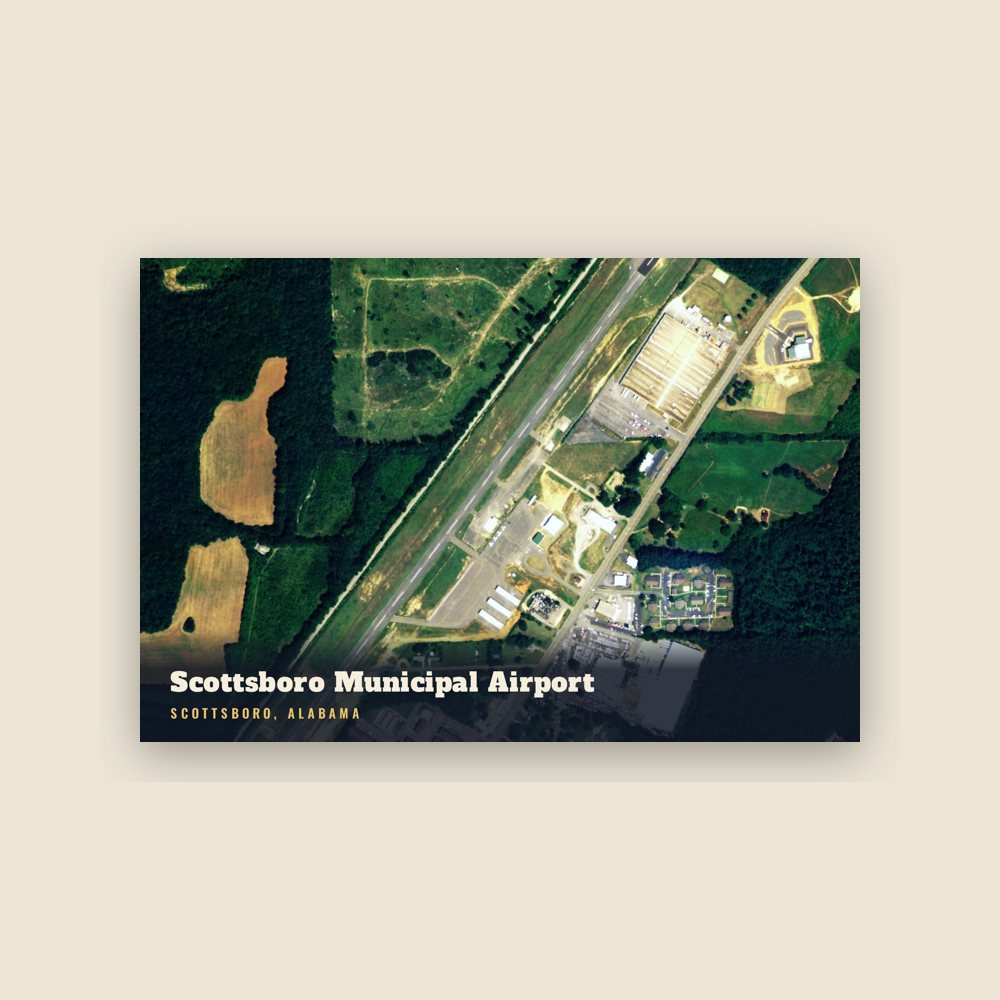
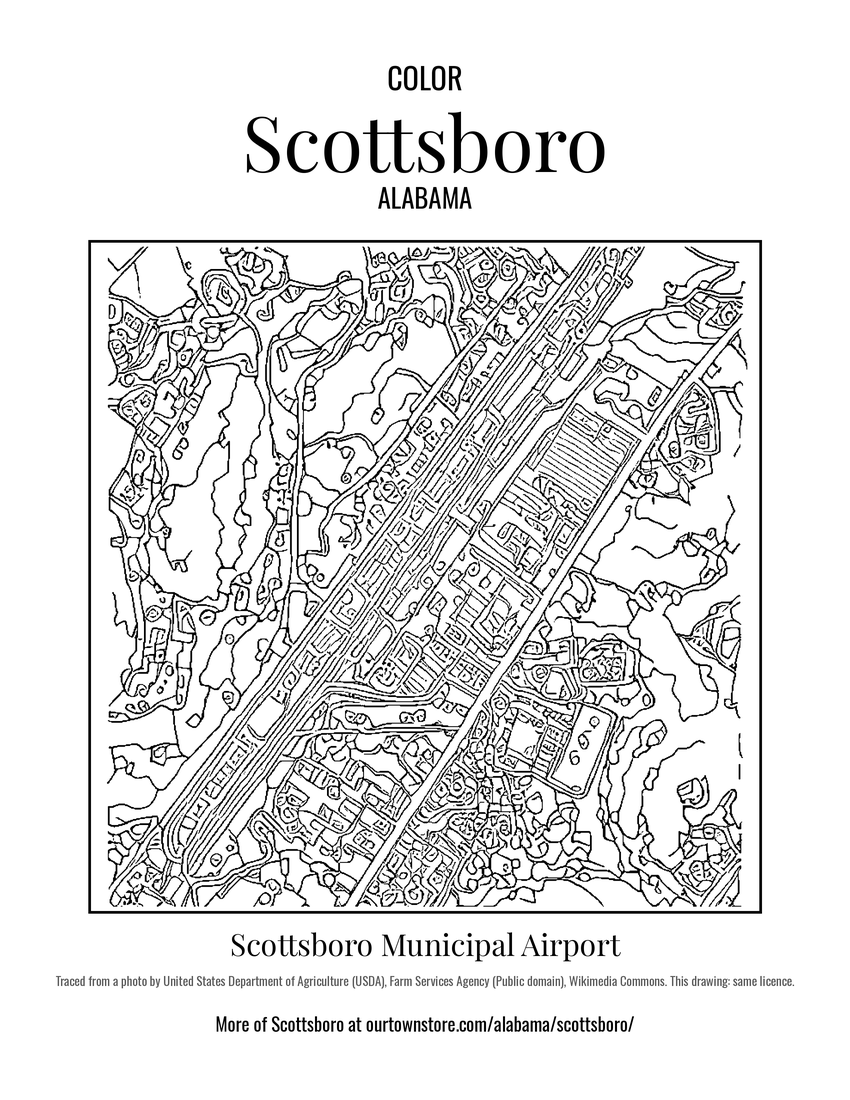 Scottsboro Municipal Airport
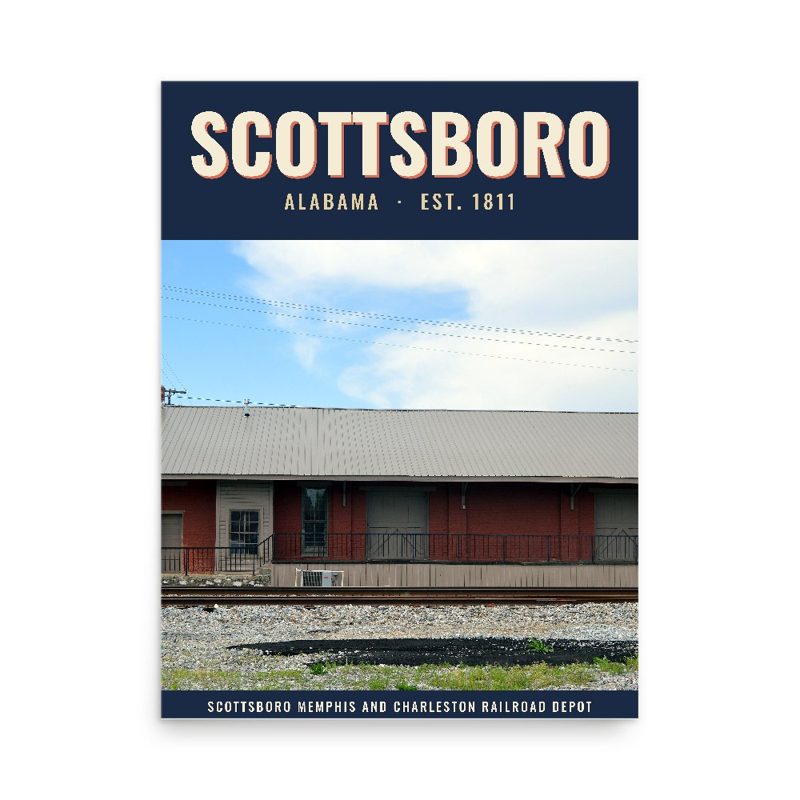
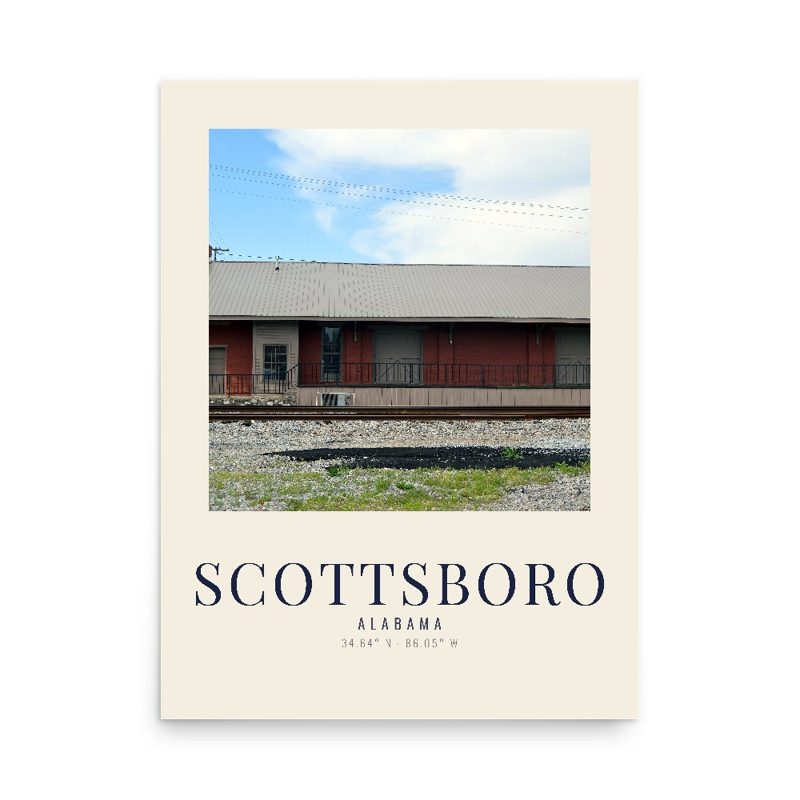
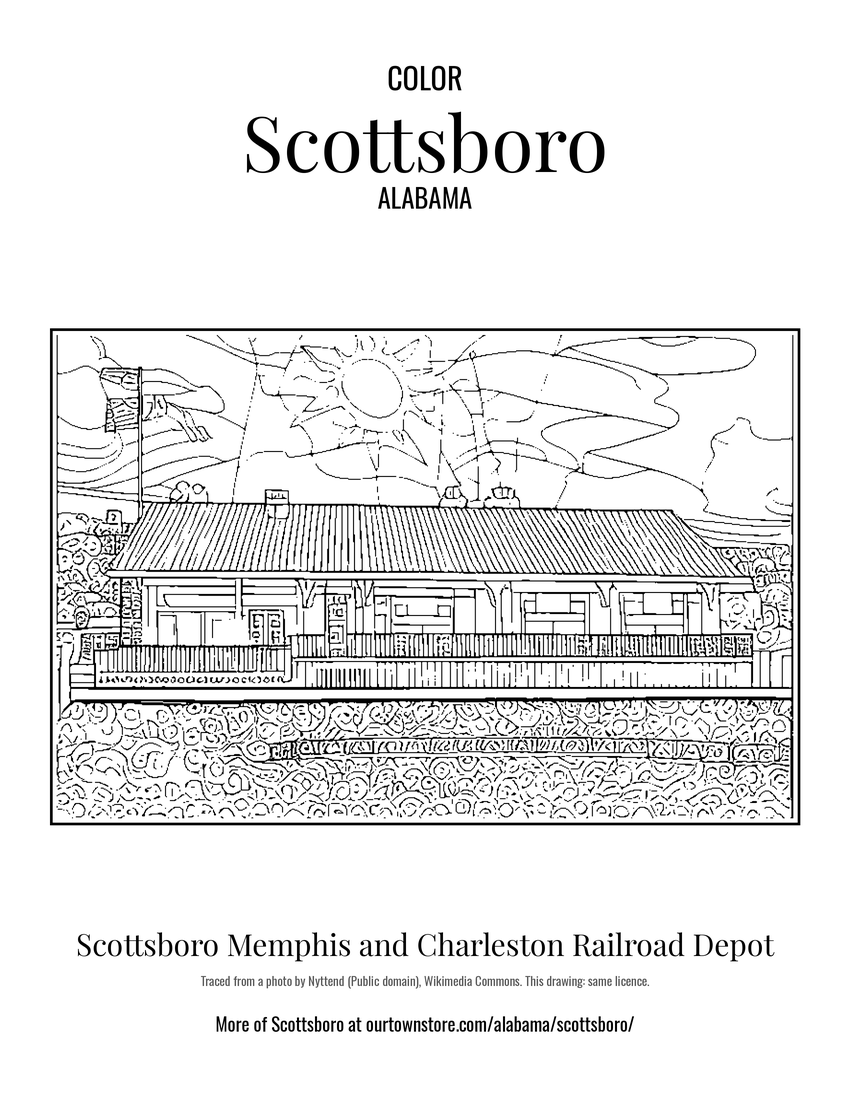 Scottsboro Memphis and Charleston Railroad Depot
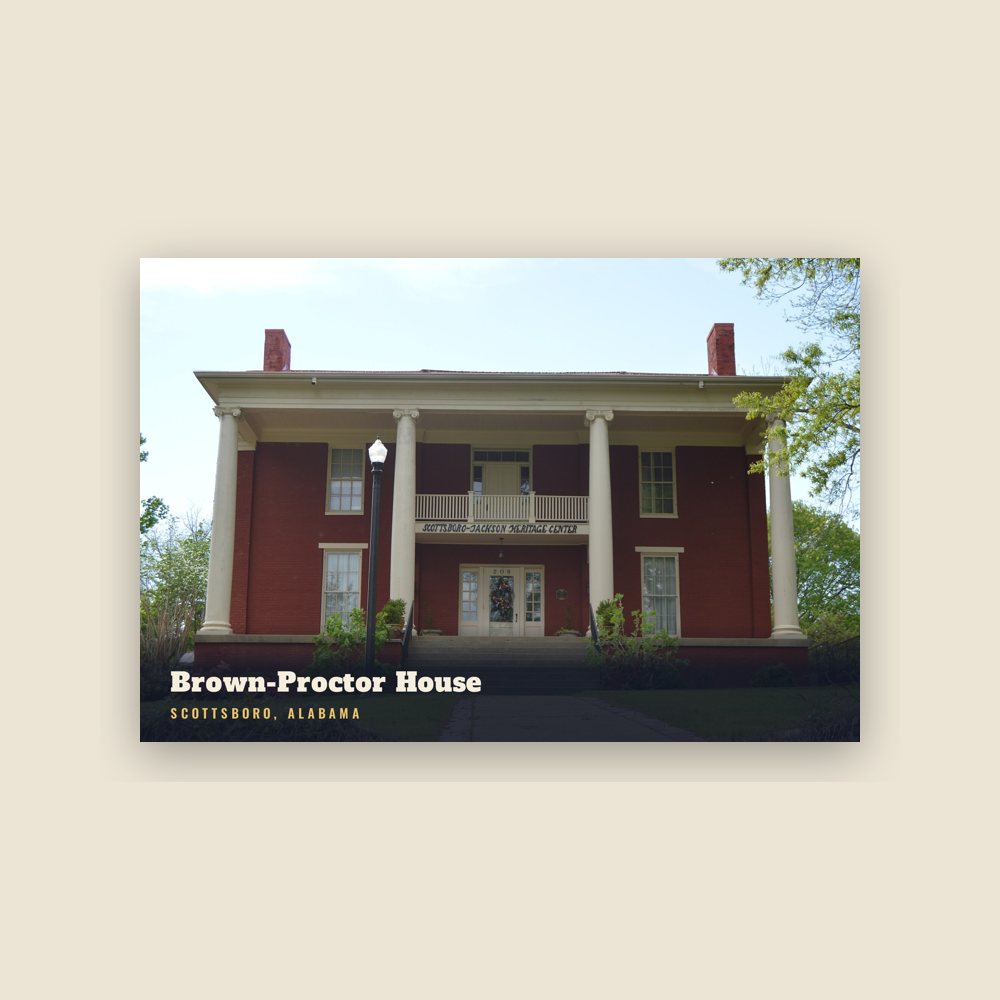
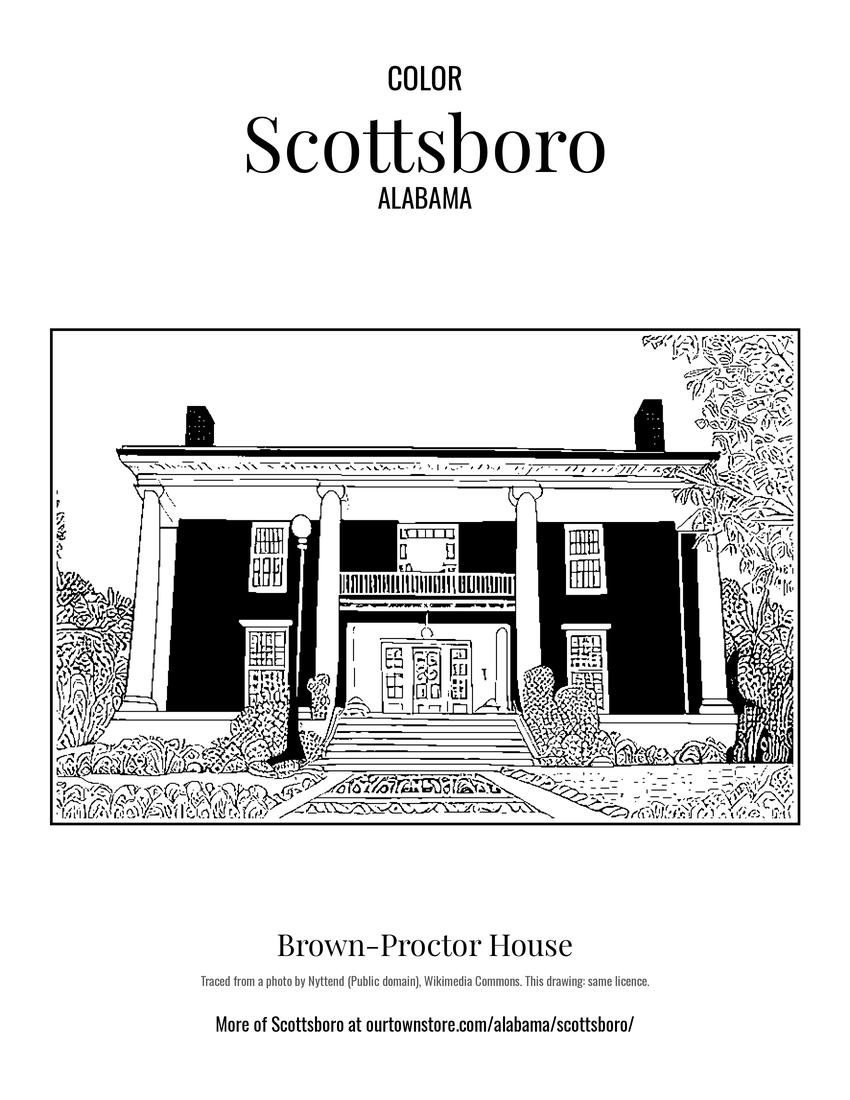 Brown-Proctor House