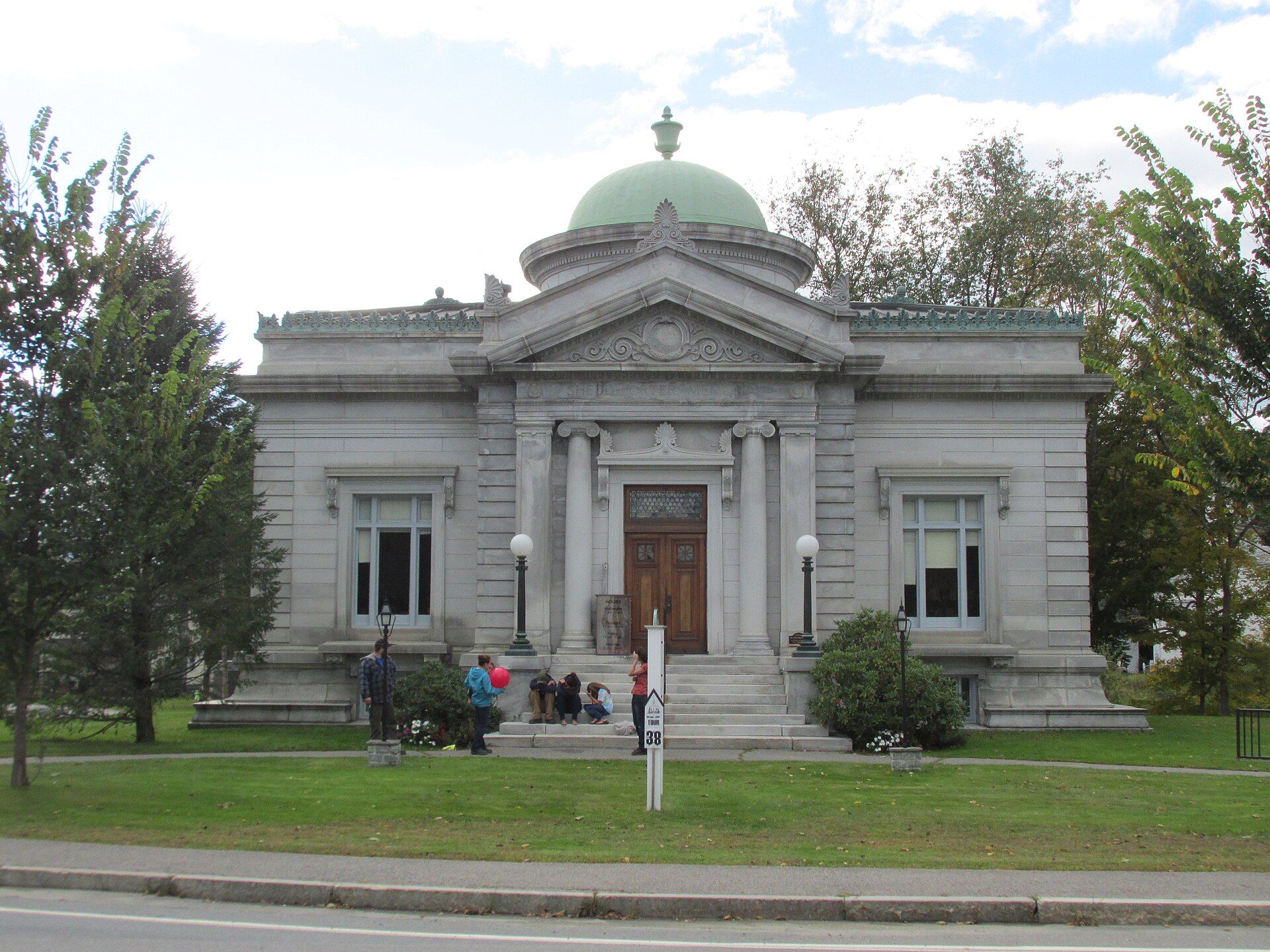
Alstead is home to Feuer State Forest. Landmarks include Jewett-Kemp-Marlens House, Shedd-Porter Memorial Library and Hutchinson House. Alstead is the birthplace of Samuel Thomson, herbalist.
Every piece is drawn from Alstead's own map data and historic archives, then printed and shipped from the USA when you order. No two towns look alike.
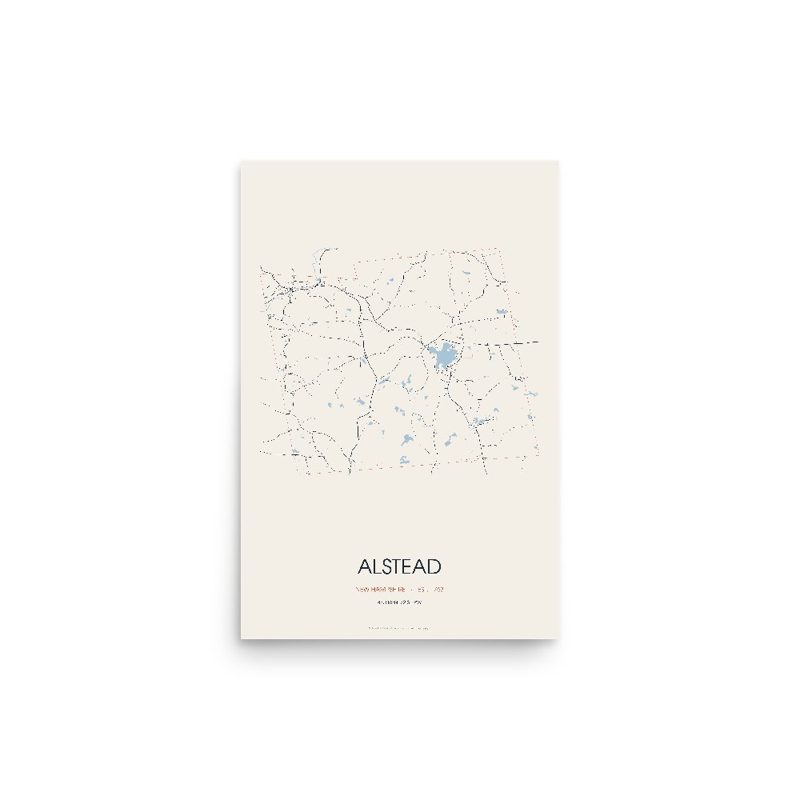
Every road in town, on archival matte paper
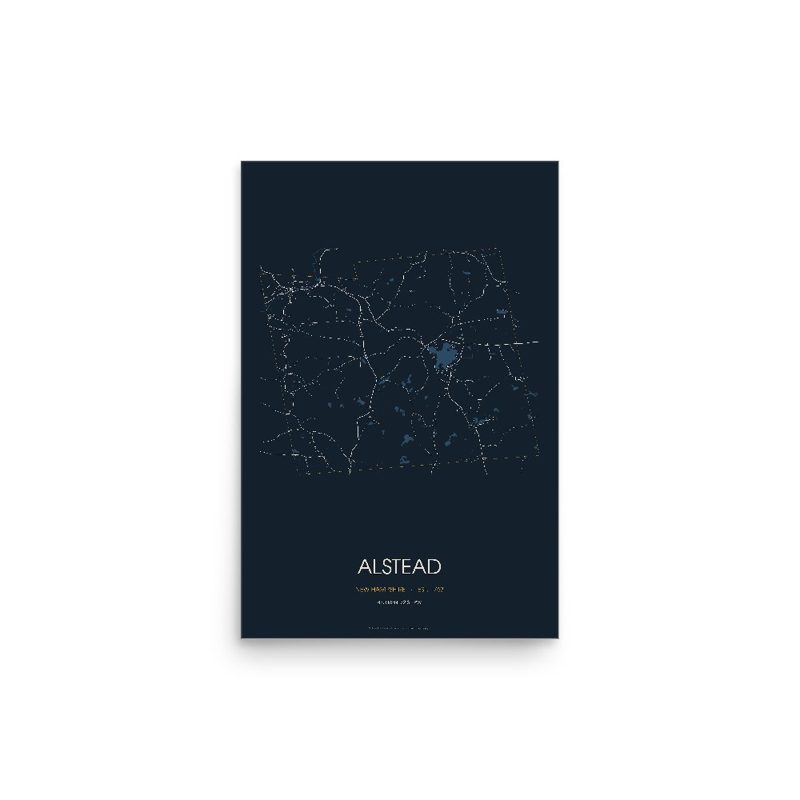
The same map, in navy and silver
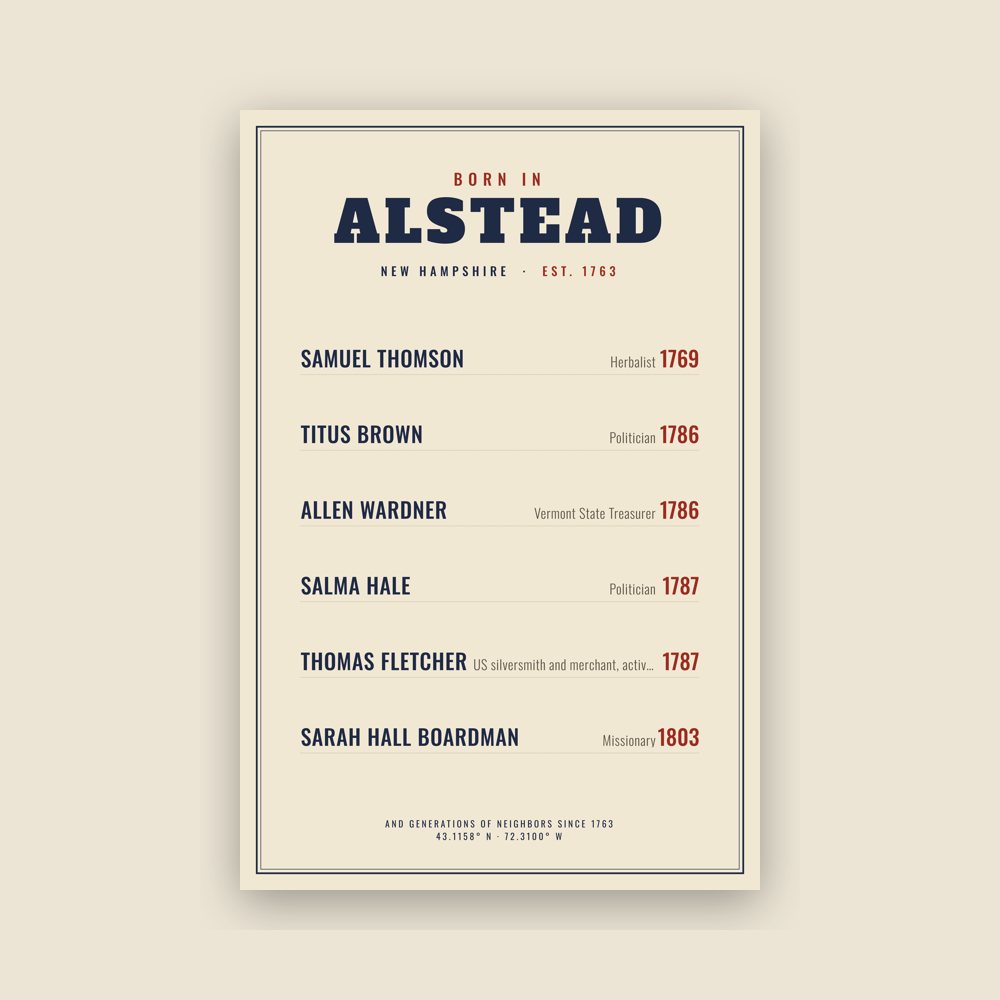
Famous natives, by birth year
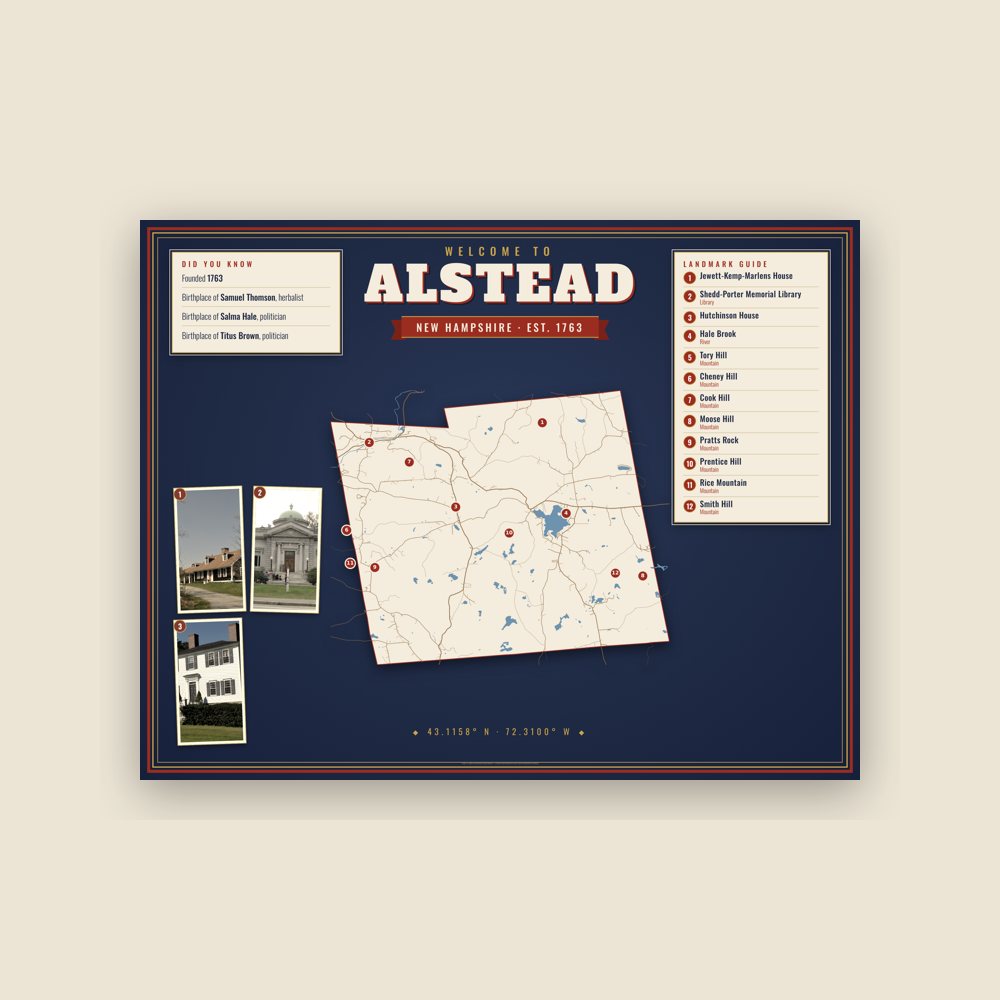
Map of local landmarks, washable fabric
Heavy-blend fleece, street map printed on the back
Soft Bella+Canvas jersey
Glossy ceramic, dishwasher safe
Ceramic keepsake, gold ribbon
Weatherproof, for the front walk
24″×16″, printed coir-look fibers, rubber back
12″×12″ printed wood, ready to hang
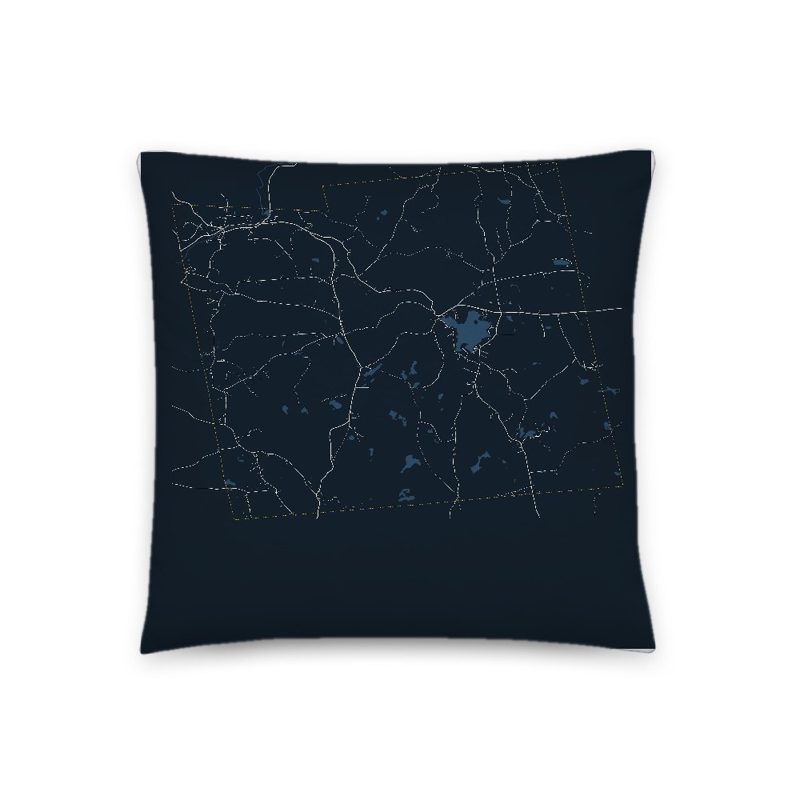
Soft-touch, zip cover
Sturdy all-over-print tote
Glossy top, cork back
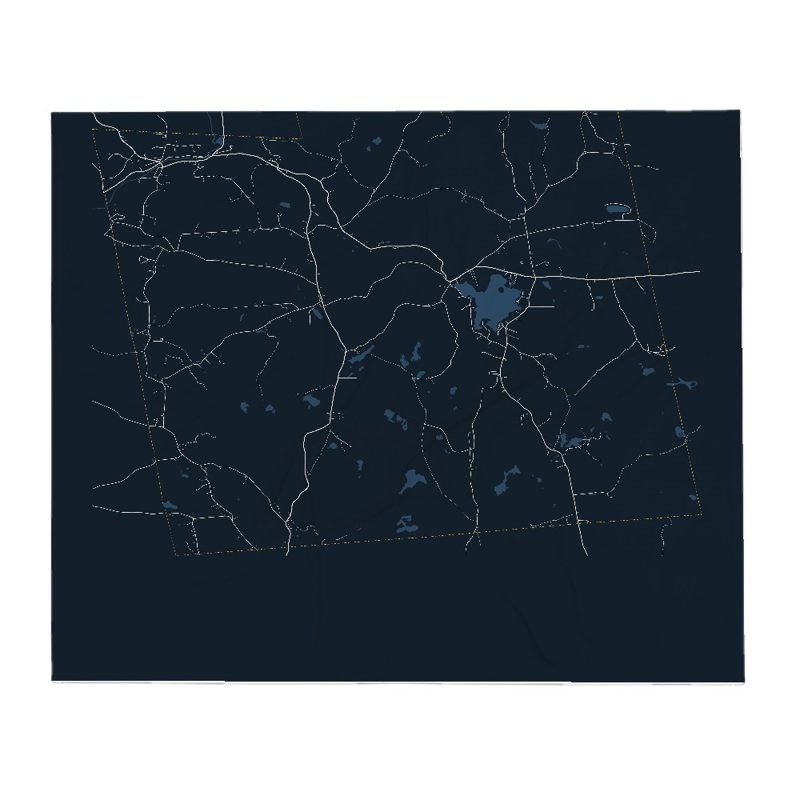
Soft fleece, 50″×60″
20 oz, double-wall stainless
Population 2010: 1,937 → 2020: 1,864
From Wikidata (CC0).
The town was chartered by Massachusetts Governor Jonathan Belcher in 1735 as one in a line of nine forts intended to protect southwestern New Hampshire from Indian attack. It was granted as "Newton" or "Newtown" in 1752 by Governor Benning Wentworth, but would be incorporated in 1763 as Alstead. It was named for Johann Heinrich Alsted, who compiled an early encyclopedia that was popular at Harvard College. Settled about 1764, Alstead would be one of the towns that wavered in its allegiance after the Revolutionary War. It decided to join Vermont in April 1781, but at the insistence of George Washington, returned to New Hampshire authority early the next year.
Formerly known as "Paper Mill Village", Alstead is the location of one of the state's first paper mills. It was established in 1793 on the Cold River by Ephraim and Elisha Kingsbury. Paper was then a rare and expensive product, made by chopping rags of linen and cotton cloth into pulp. The mill was destroyed by fire in 1880. While Alstead was basically an agricultural community, its streams and ponds once powered a variety of small mills. A turbine water mill at East Alstead is probably the last of its type anywhere in the region.
Shedd-Porter Memorial Library, built in 1909–1910 in the Beaux-Arts style, was a gift to Alstead and Langdon by native son John G. Shedd, president of Marshall Field's department store in Chicago. Another native son philanthropist, Charles M. Vilas, gave a large public recreation area, school building and the only carillon in Cheshire County.
On the weekend of October 8–9, 2005, parts of Alstead were devastated by a severe flood. Heavy rain in Cheshire County—at least 7 inches (180 mm) in a 30-hour period—caused the Cold River and its tributaries to swell. The streamflows, which were swollen by the surge of water from Warren Brook, exceeded a 500-year recurrence interval. The storm created major property damage in Alstead, Langdon, and Walpole along the Cold River and Warren Brook. It washed away homes, cars, and 4 miles (6 km) of Route 123. Four inhabitants of the town were killed. A Save Our History grant from The History Channel provided funding to the Alstead Historical Society and several students of the local high school, who wrote and printed a book called Too Much Water, Too Much Rain, chronicling the disaster and its aftermath.
Adapted (trimmed) from the Wikipedia article Alstead, New Hampshire, revision 1378459444 by its contributors, licensed CC BY-SA 4.0.
We share a part of every Alstead sale with local partners, and we'd love to print from your collection. Old photographs, maps and postcards make the best keepsakes.
Partner with us