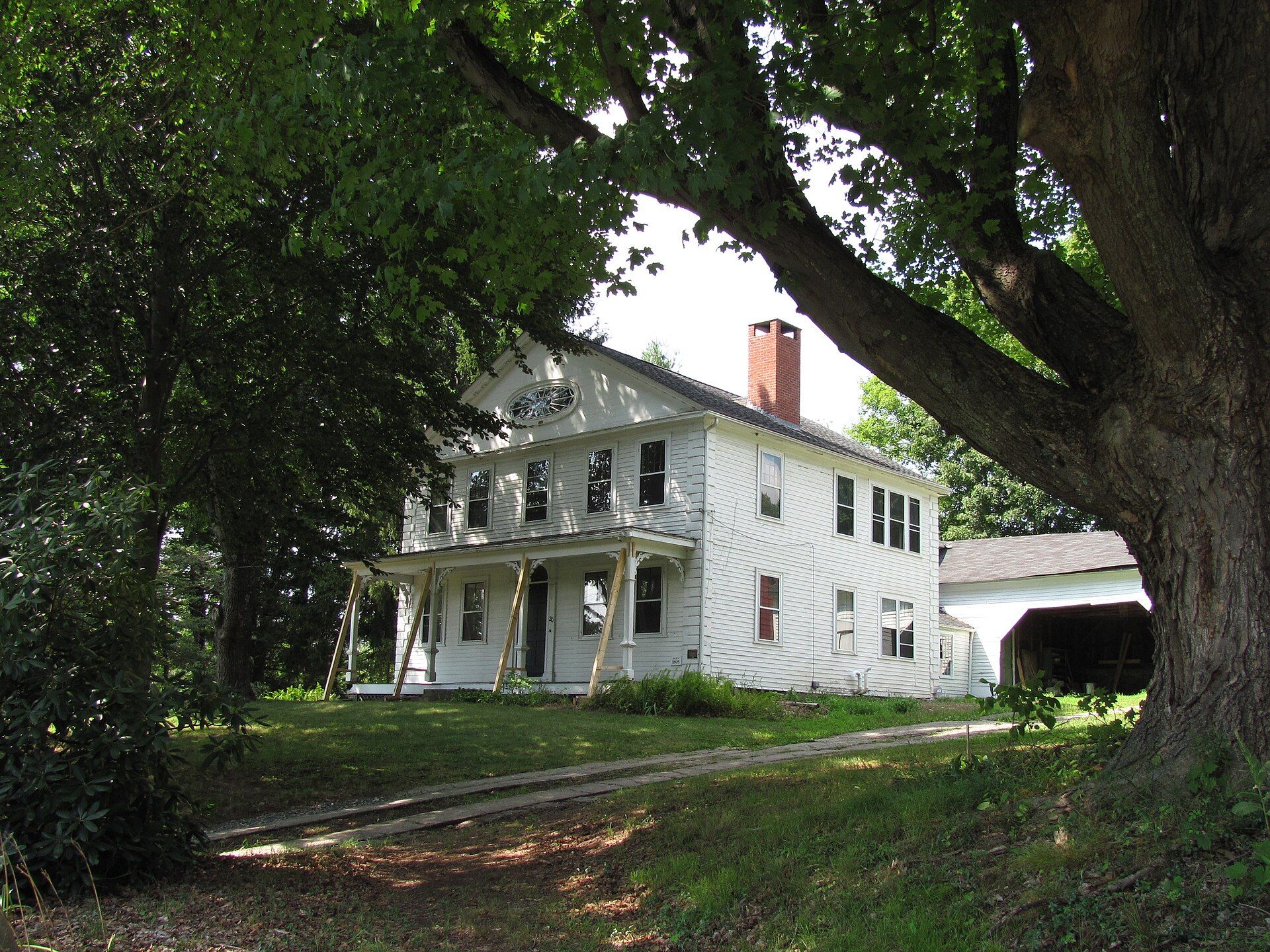
In the mid-17th century, pioneering English explorers moving up the Connecticut River Valley in search of fertile farmlands and game discovered the area and settled Southwick. Landmarks include Babb's Beach, Laflin-Phelps Homestead and Hampshire and Hampden Canal. Southwick is the birthplace of William W. Boyington, politician and architect.
Every piece is drawn from Southwick's own map data and historic archives, then printed and shipped from the USA when you order. No two towns look alike.
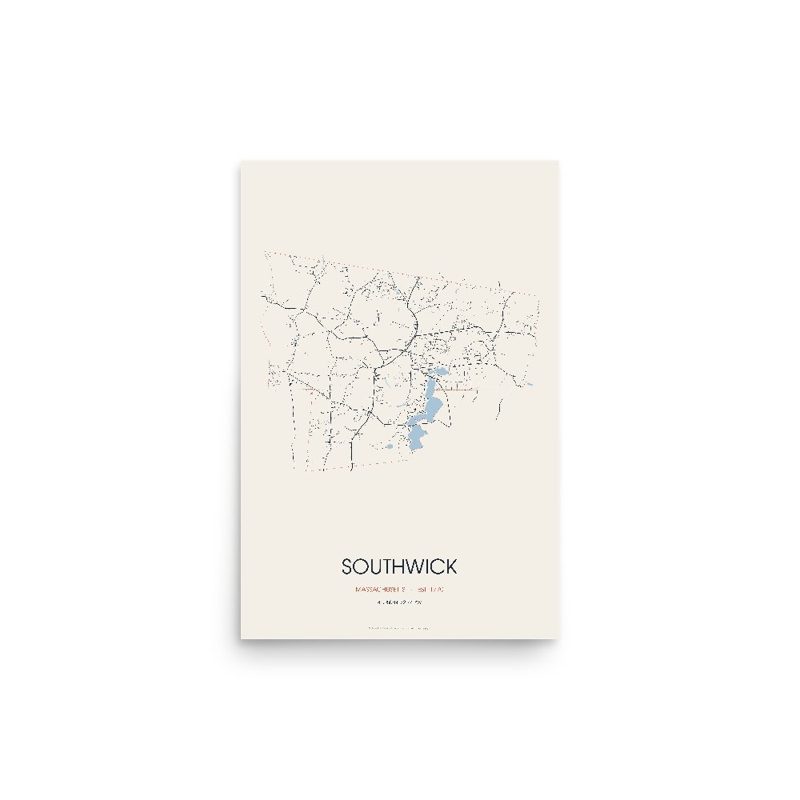
Every road in town, on archival matte paper
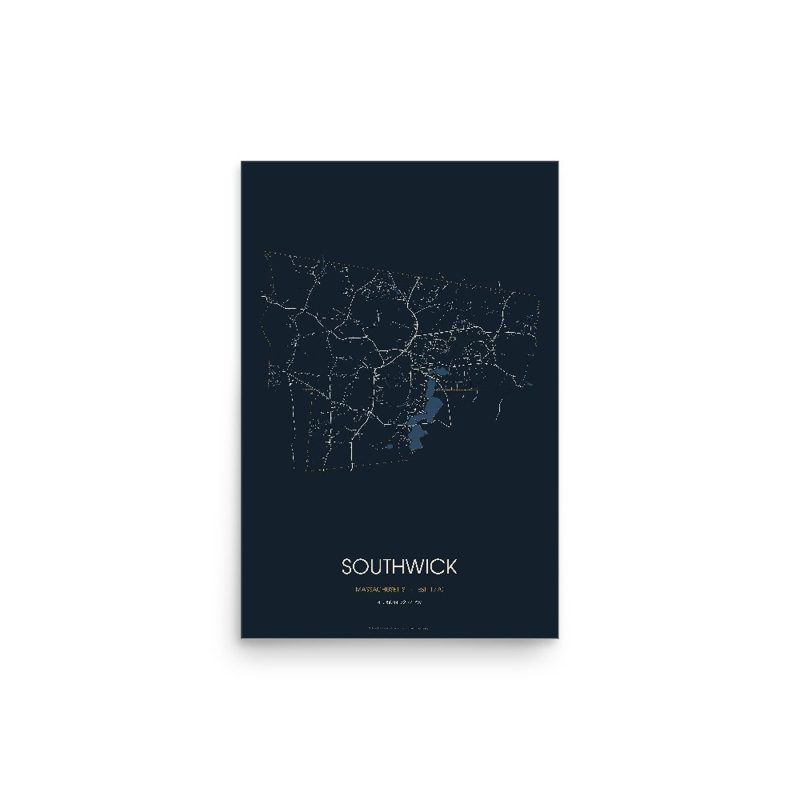
The same map, in navy and silver
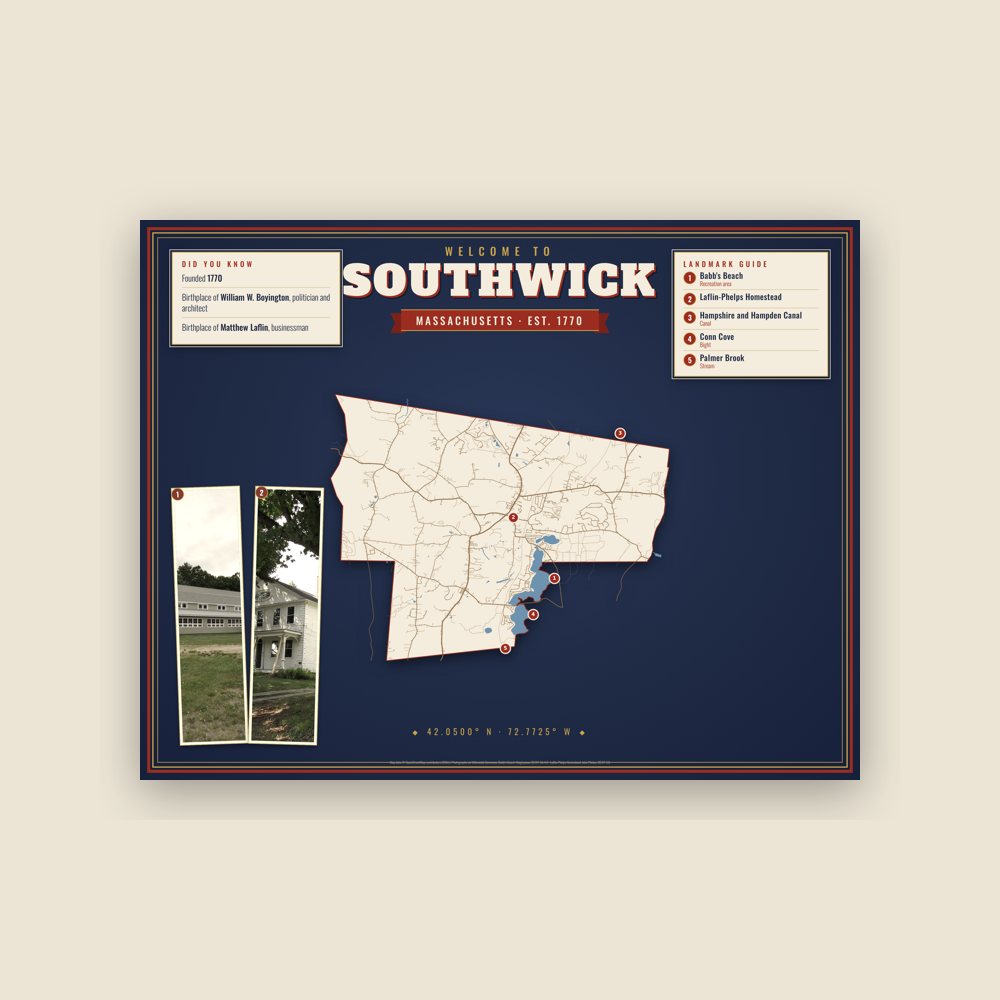
Map of local landmarks, washable fabric
Heavy-blend fleece, street map printed on the back
Soft Bella+Canvas jersey
Glossy ceramic, dishwasher safe
Ceramic keepsake, gold ribbon
Weatherproof, for the front walk
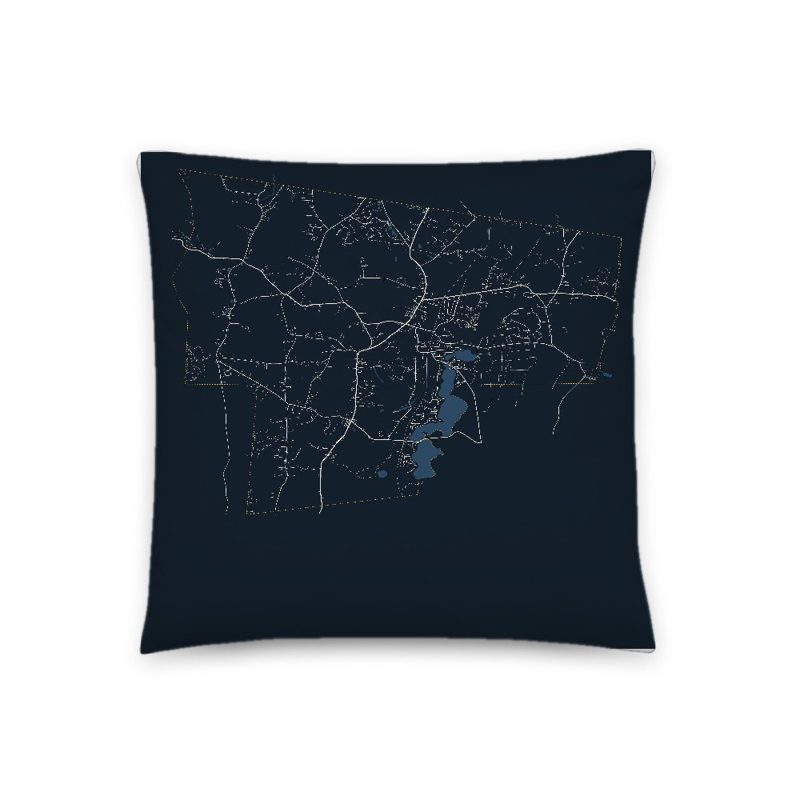
Soft-touch, zip cover
Sturdy all-over-print tote
Glossy top, cork back
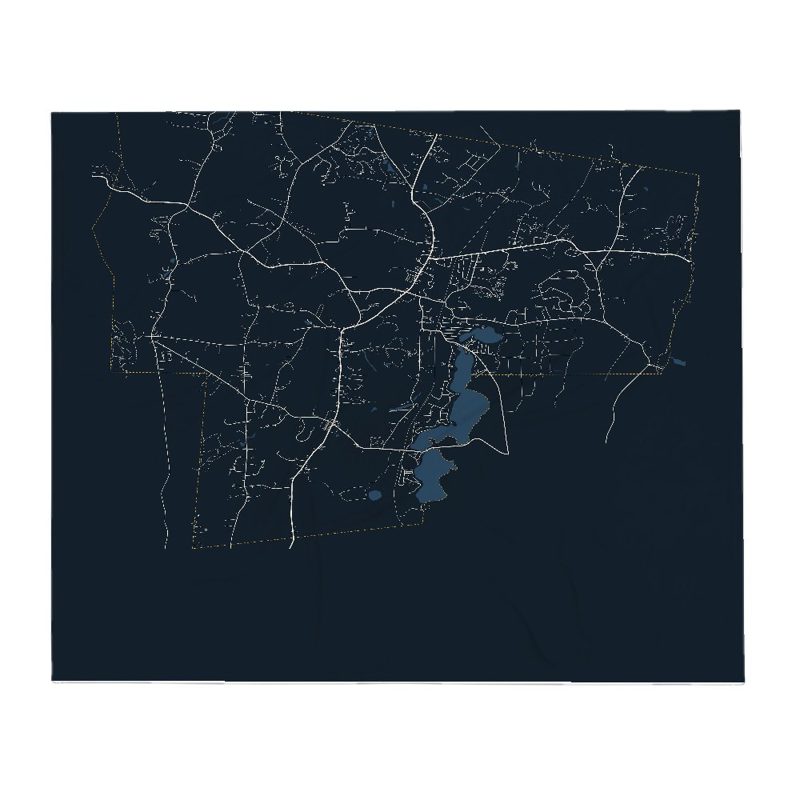
Soft fleece, 50″×60″
20 oz, double-wall stainless
Population 2010: 9,502 → 2020: 9,232
From Wikidata (CC0).
In the mid-17th century, pioneering English explorers moving up the Connecticut River Valley in search of fertile farmlands and game discovered the area and settled Southwick. It became a farming community, defined as the Southern (South-) village (-wick) part of the town of Westfield. Early on, it was nicknamed "Poverty Plains" because the land was thought to be infertile. Its first residential home was built by Samuel Fowler and his wife Naomi Noble on what is now College Highway (US 202 and MA 10), approximately one-quarter mile (0.4 km) north of the current town center.
In colonial times, church attendance was mandatory. The 800 Christian residents of Southwick in the 1760–1770s were required to travel to Westfield to congregate. Their envisioned parish could only be established by first building their church community. On November 7, 1770, Southwick was incorporated as a separate district of Westfield. The area of Southwick became somewhat smaller in 1770. The southernmost portion of Southwick joined Suffield, Connecticut, as the result of a simultaneous secession of citizens in that part of the village.
Southwick became a fully independent town in 1770. The town remained divided until 1793 when Massachusetts claimed the area (known as the "Southwick Jog"). A border dispute continued until 1804 when the current boundary was established through a compromise between Connecticut and Massachusetts. As a result of this border resolution, Southwick is the southernmost town in western Massachusetts.
In the early 19th century, the Farmington Canal and the Hampshire and Hampden Canal were built to link New Haven, Connecticut to Northampton through Southwick. Irish immigrants came to the area to labor on this project. Developers spoke of Southwick's potential, calling it the "Port of the World". Traces of the canal can still be found in the Great Brook and Congamond Lakes area. Due to winter freezing, summer drought, and wildlife impact (beaver dams, etc.), the canal was phased out in favor of a railroad.
Laflin-Phelps Homestead was built soon after the area was settled and remains the oldest standing structure in Southwick.
Completed in the late 1840s, the New Haven and Northampton Company's railroad was built alongside the canal. With the railroad came the ice industry and tourist resorts around the Congamond Lakes (which were named Wenekeiamaug by the previous native peoples). Along with the construction of a small amusement park, numerous elaborate hotels and dance halls were constructed. During the Industrial Era, summer vacationers and day-trippers would escape to Southwick from cities connected by the Northeast Railroad Corridor including New York City, Albany, Boston, Worcester, Hartford, and especially Springfield. There was a special stop near the lakes where visitors would disembark to swim and/or pile into canopied pleasure boats.
During WWI and WWII, trains loaded with soldiers would pass through town. It has been noted that local girls would gather letters thrown by the soldiers from the train and forward them to the intended recipients at the post office. The last train to pass along these tracks was circa 1976. As of 2022, the old railway was converted into a rail trail leading to Granby, Connecticut, known as the Farmington Canal Rail Trail.
All of Southwick's grand hotels and ornate train stations have since been torn down. Babb's Roller Skating Rink on the Suffield side of Congamond Lakes is all that remains of the amusement park.
Adapted (trimmed) from the Wikipedia article Southwick, Massachusetts, revision 1377118966 by its contributors, licensed CC BY-SA 4.0.
We share a part of every Southwick sale with local partners, and we'd love to print from your collection. Old photographs, maps and postcards make the best keepsakes.
Partner with us