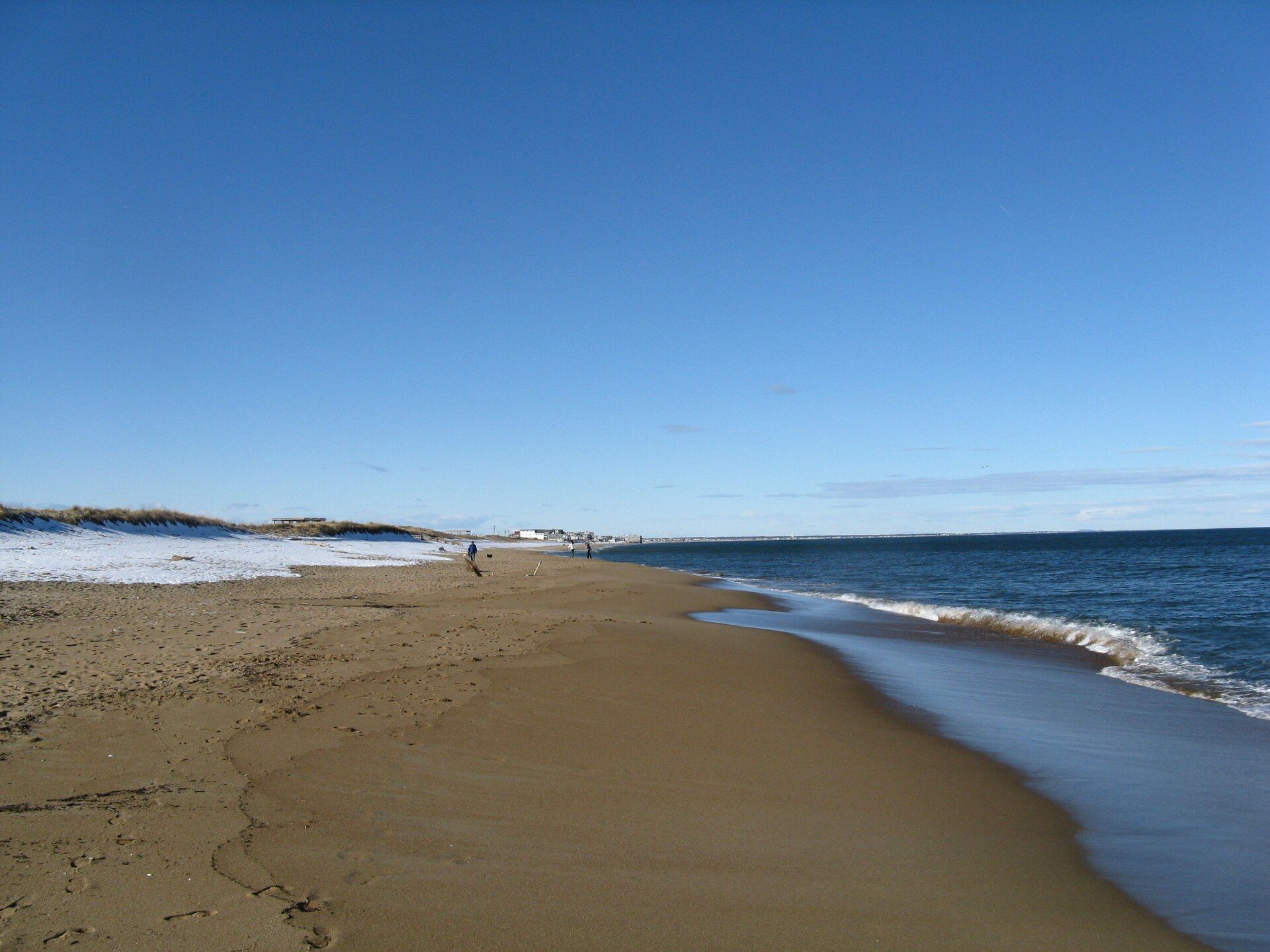
Salisbury is a small coastal beach town and summer tourist destination in Essex County, Massachusetts, United States. Landmarks include Salisbury Beach State Reservation, Ann's Diner and Chain Bridge. Salisbury is the birthplace of Caleb Cushing, politician.
Every piece is drawn from Salisbury's own map data and historic archives, then printed and shipped from the USA when you order. No two towns look alike.
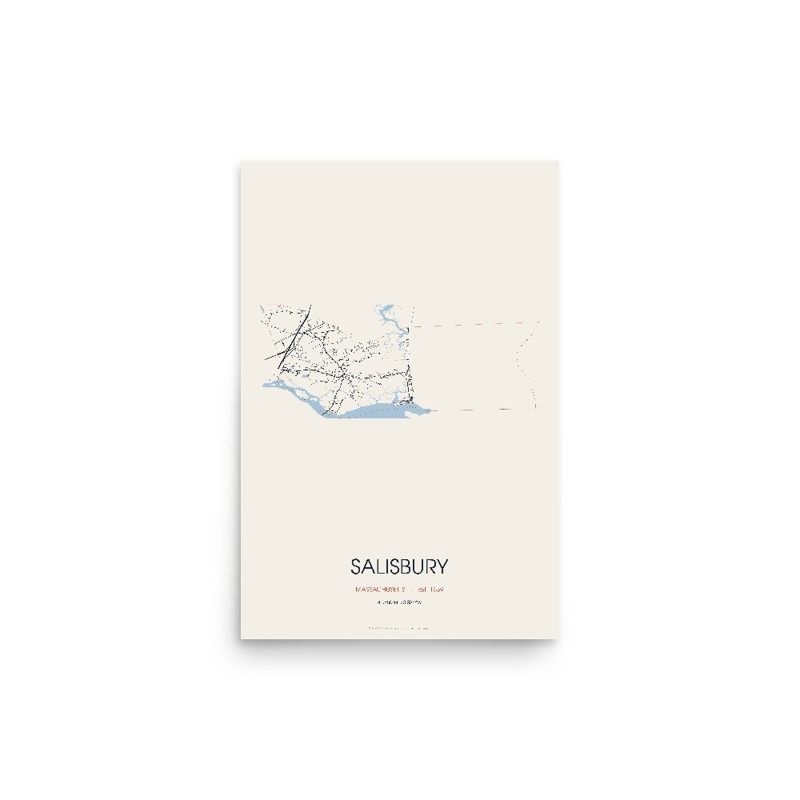
Every road in town, on archival matte paper
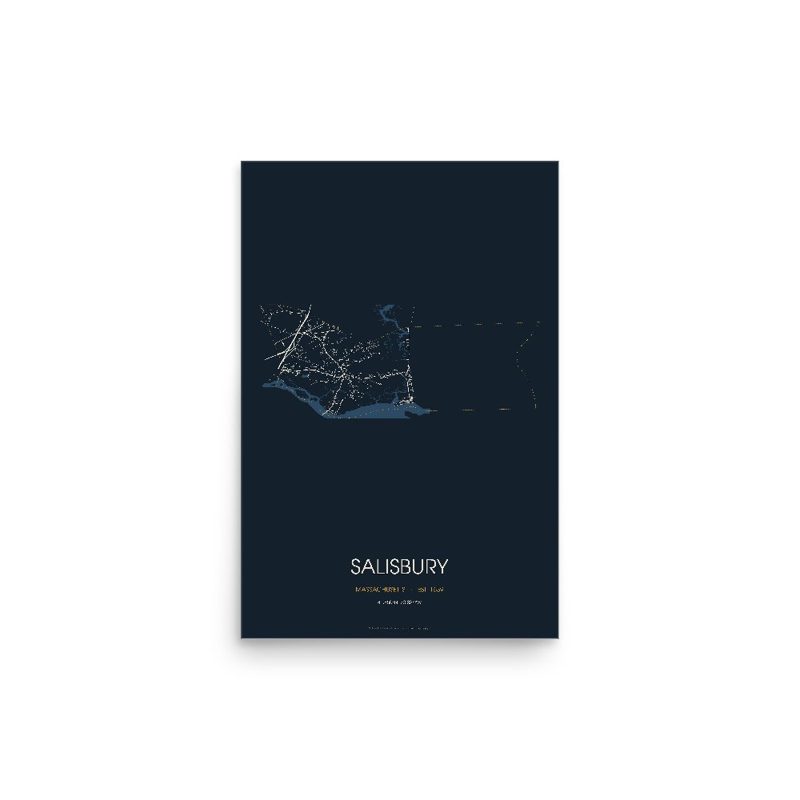
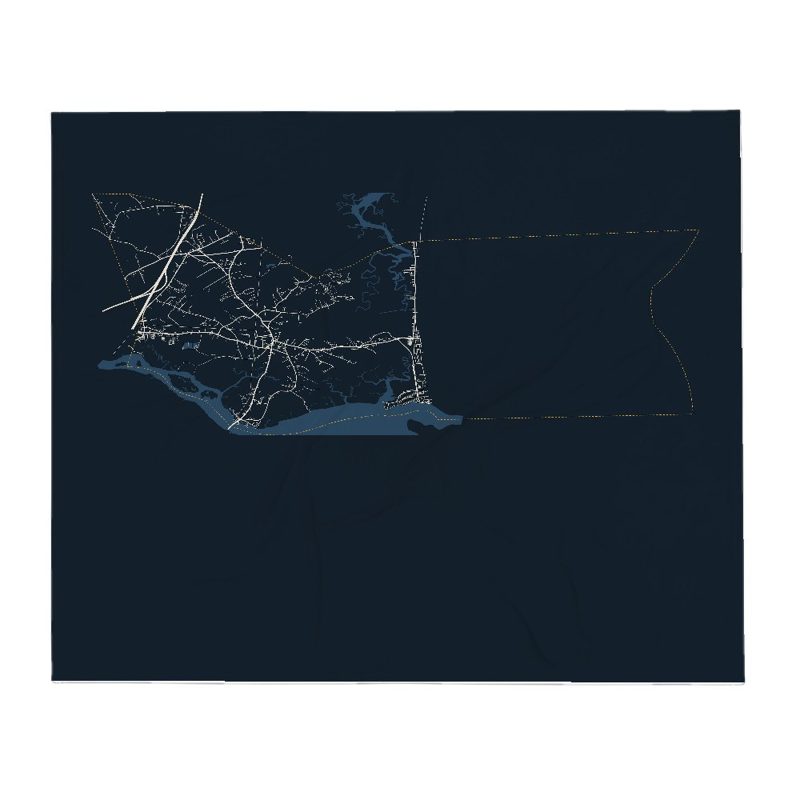
The same map, in navy and silver
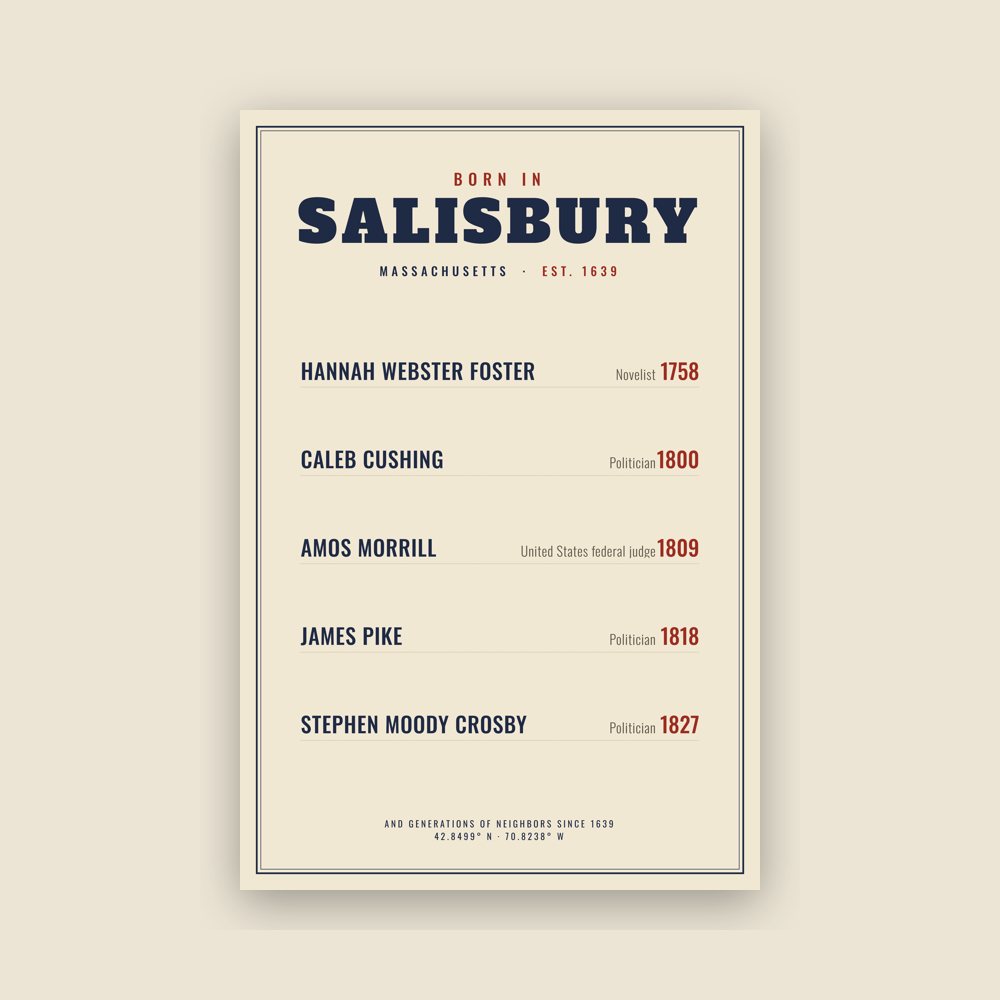
Famous natives, by birth year
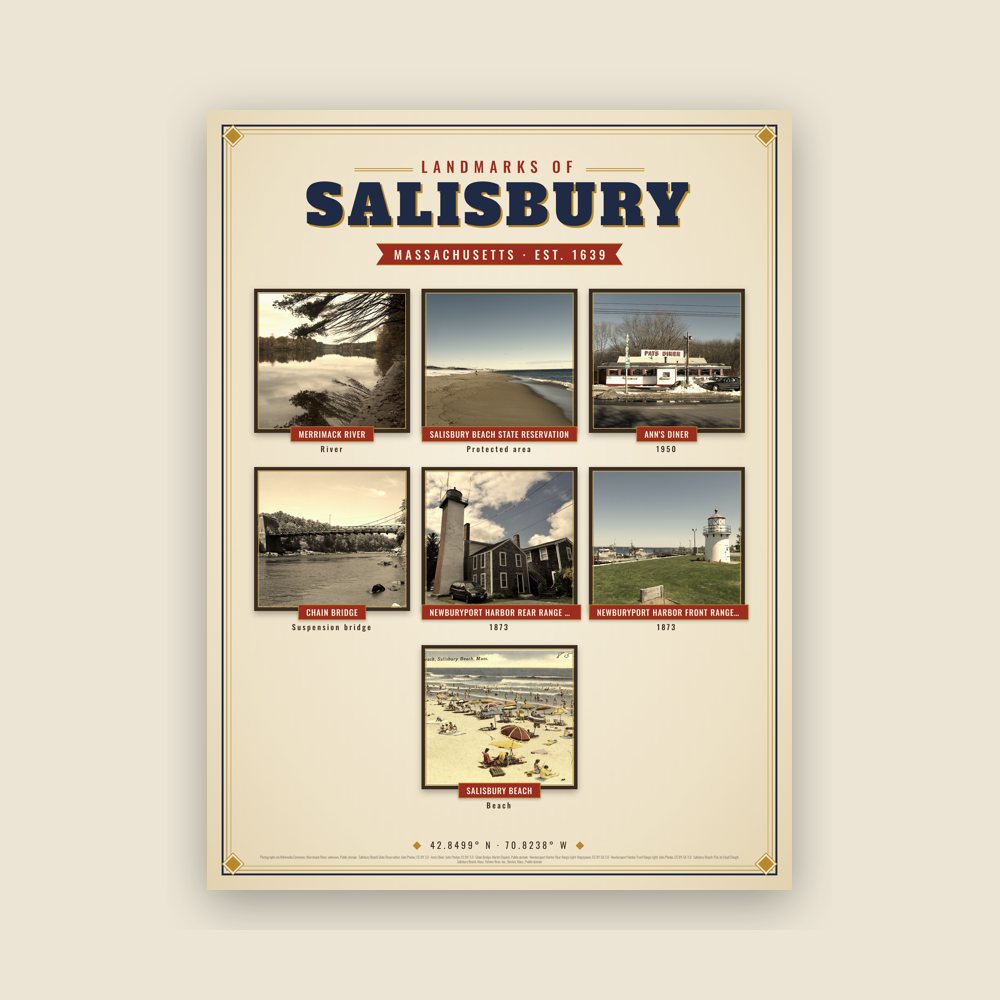
Nine local landmarks, archival matte
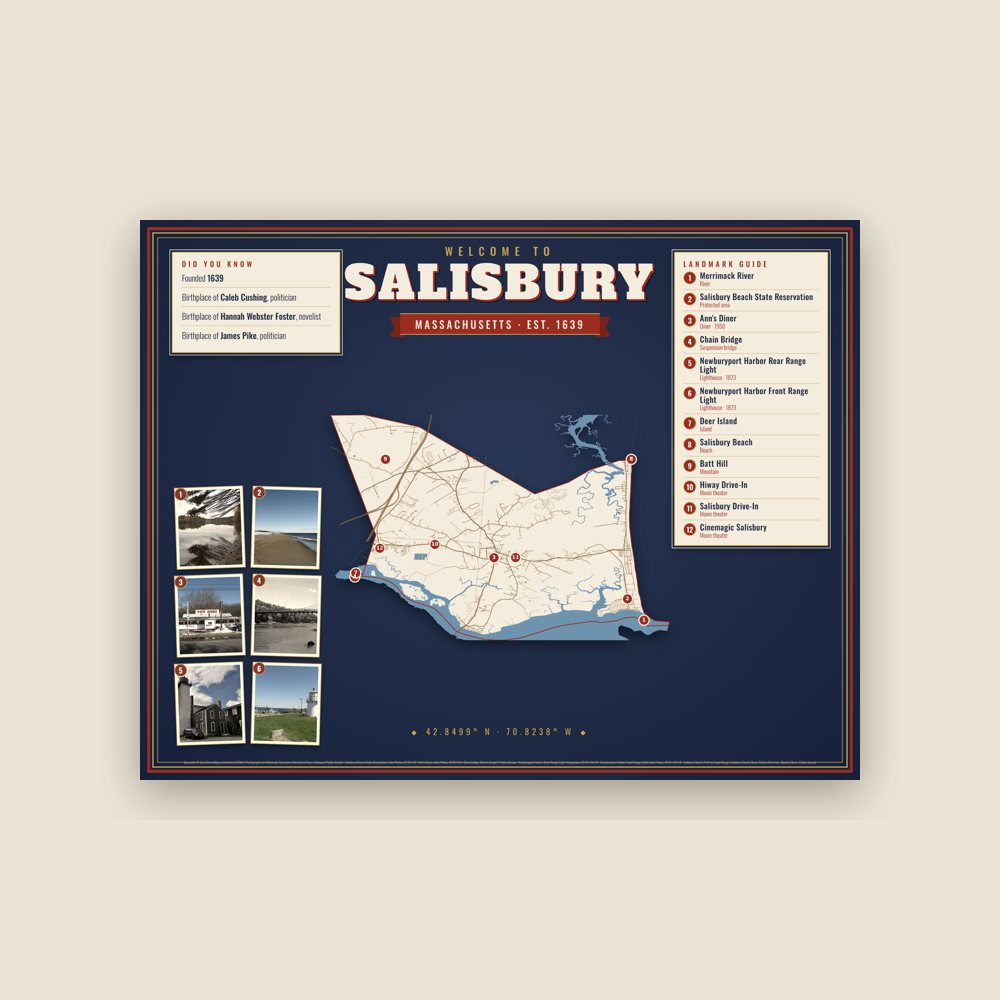
Map of local landmarks, washable fabric
Heavy-blend fleece, street map printed on the back
Soft Bella+Canvas jersey
Glossy ceramic, dishwasher safe
Ceramic keepsake, gold ribbon
Weatherproof, for the front walk
Soft-touch, zip cover
Sturdy all-over-print tote
Glossy top, cork back
Soft fleece, 50″×60″
20 oz, double-wall stainless
Population 2010: 8,283 → 2020: 9,236
From Wikidata (CC0).
The area currently known as Salisbury was inhabited for tens of thousands of years prior to European colonization. At the Morrill Point burial mound site on the north shore of the Merrimack River, there are human remains dating to 7,000 years ago with some dating suggesting settlement there as early as 8,500 years ago.
At the time of European contact and colonization, the area north of the Merrimack River was inhabited by the Pentucket Tribe of the Pennacook confederation, who lived at the coastline seasonally to fish in the coastal wetlands. Unlike other towns of what would become Essex County that negotiated the terms of European settlement with native inhabitants, Salisbury was settled under the jurisdiction of a land grant from the Massachusetts Bay Colony General Court and laid out in a compact defensive arrangement with a garrison house, night watch, and militia for the purpose of defending against native attack.
Salisbury was colonized by the English in 1638 as Colchester, and incorporated in 1640 as Salisbury, after Salisbury in Wiltshire, England, the birthplace of Christopher Batt who was appointed to train the colonists' militia. The original settlement was laid out in a compact semicircle, which allowed the residents to quickly reach the garrison house, out of a fear of attack by surrounding native peoples. Those roads still exist, though the shape today is triangular, being bounded by Elm Street, School Street and Bridge Road. A second threat came from eastern wolves, which were plentiful, and which killed the livestock and dug in the graveyard.
Salisbury was one of the six towns originally incorporated into Old Norfolk County. However in 1679, when four of those towns were broken off to form the Province of New Hampshire, Salisbury was annexed by Essex County.
The original residents, including Richard Currier, were given one small house lot near the center of town, and one larger planting lot just outside the center for farming. Families also owned large sections of "sweepage lots" near the beach, where apparently they harvested the salt marsh hay. At the time, the area was almost entirely unbroken virgin forest, which had to be cleared for the construction of houses and the planting of fields.
Richard Currier was a millwright and was one of the original settlers of Salisbury. He is listed in the first division of house lots in 1640 and received additional land in 1641 and 1642. In 1654 there were sixty commoners in Salisbury and they voted that thirty families were to be chosen to move west of the Powwow River. Eighteen of these families were commoners and the number of commoners were increased to 26 by the time Salisbury New Town became the town of Amesbury in 1668. Richard heads the list of the eighteen commoners and was one of the signers to the Articles of Agreement between the inhabitants of the Old Town and those of the New Town, 1 May 1654.
In 1866, Beach Road was constructed across Great Marsh, providing access to the town's five miles (8 km) of pristine beach. It developed into a thriving summer resort, lined with hotels, restaurants, shops, cottages, arcades and amusement parks. A carousel called The Flying Horses, hand carved by Charles I. D. Looff, was installed in 1914. John Miller built The Sky Rocket, the beach's first roller coaster. A Dodgem ride, originally built by Max and Harold Stoeher of Methuen, operated at Salisbury Beach in one form or another from 1920 to 1980. Major entertainers provided concerts, including Glenn Miller, Ella Fitzgerald, Louis Armstrong, Frank Sinatra and Liberace.
The resort remained vibrant through the 1960s, then gradually faded. WildCat, the last roller coaster, was razed in 1976. Pirate's Fun Park, the last small amusement park, closed in 2004 to be replaced with condominiums.
Due to climate change, Salisbury's coastline has begun rapidly eroding. In March of 2024, several beachfront residents had paid $565,000 for artificial sand dunes as protection for the beachfront houses, only for it to be washed away within three days following a severe storm.
Adapted (trimmed) from the Wikipedia article Salisbury, Massachusetts, revision 1377557540 by its contributors, licensed CC BY-SA 4.0.
We share a part of every Salisbury sale with local partners, and we'd love to print from your collection. Old photographs, maps and postcards make the best keepsakes.
Partner with us