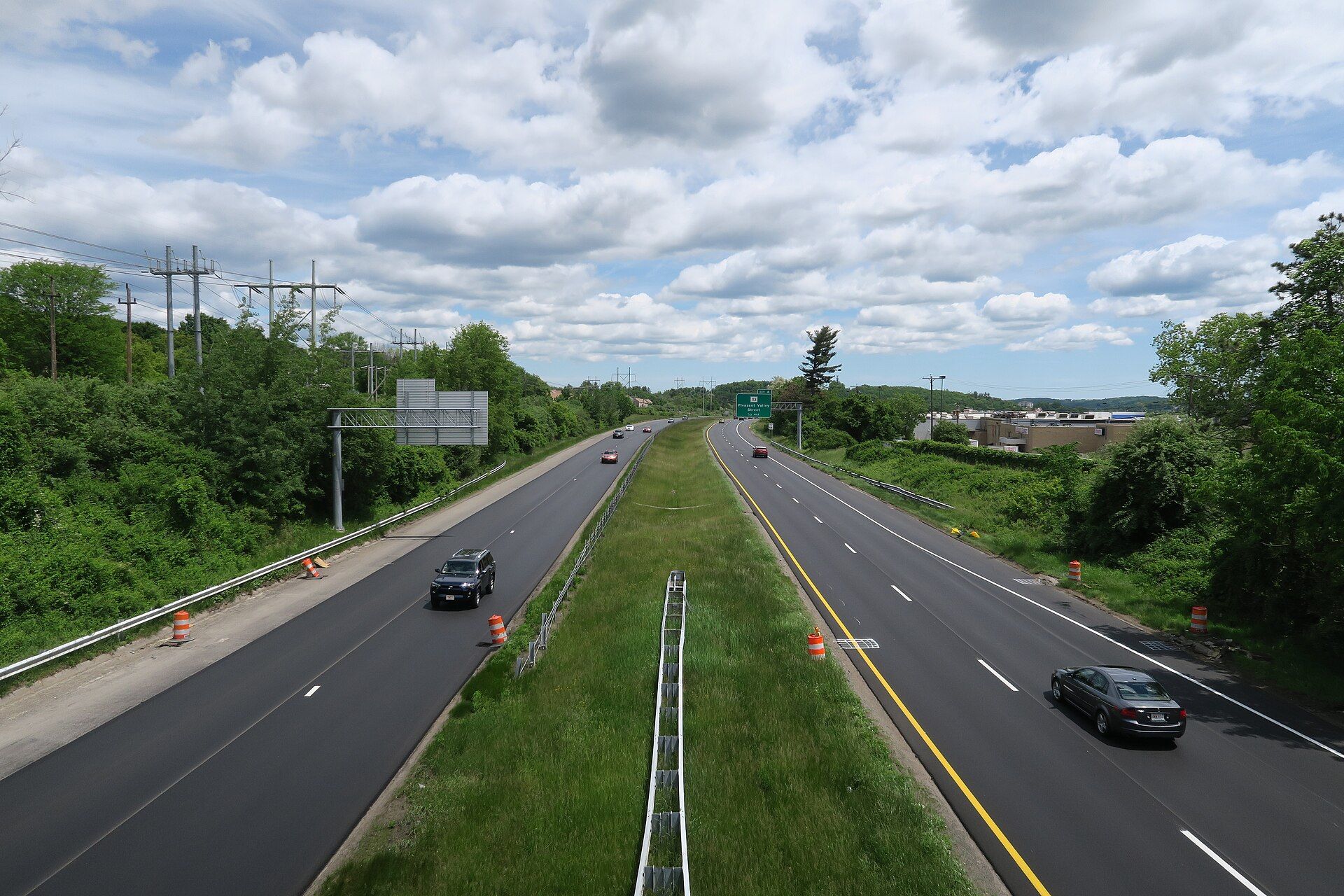
Methuen is a 23-square-mile city in Essex County, Massachusetts, United States. Landmarks include Massachusetts Route 213, First Church Congregational and Methuen Memorial Music Hall. Methuen is the birthplace of Elias James Corey, chemist.
Every piece is drawn from Methuen's own map data and historic archives, then printed and shipped from the USA when you order. No two towns look alike.
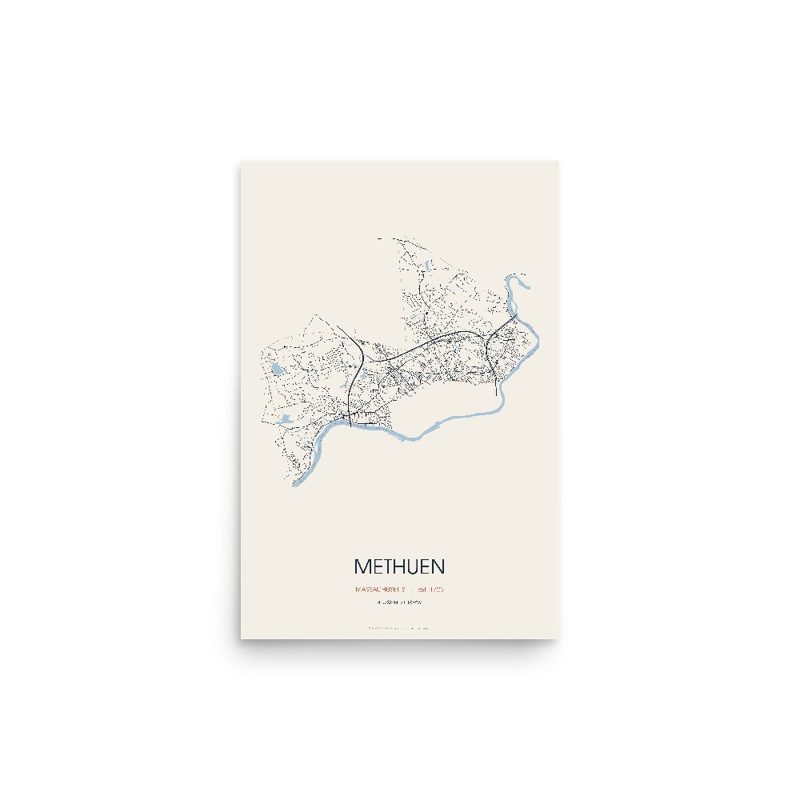
Every road in town, on archival matte paper
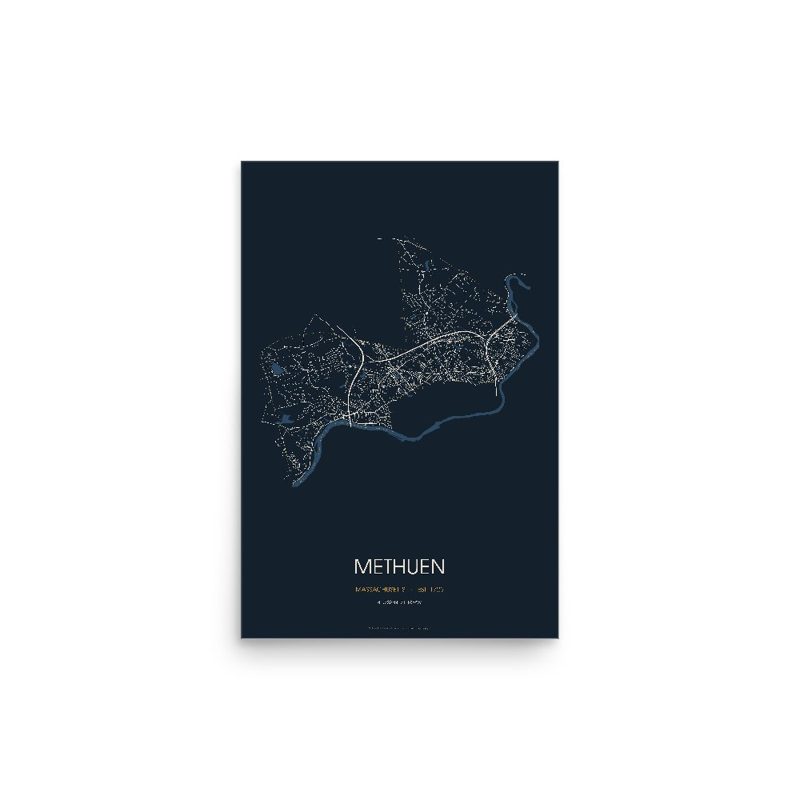
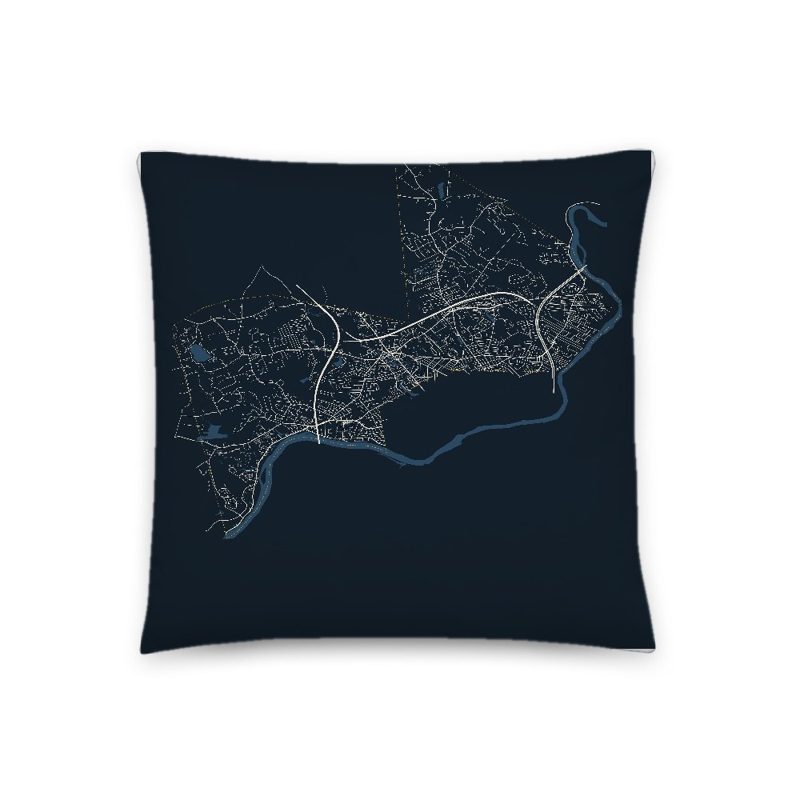
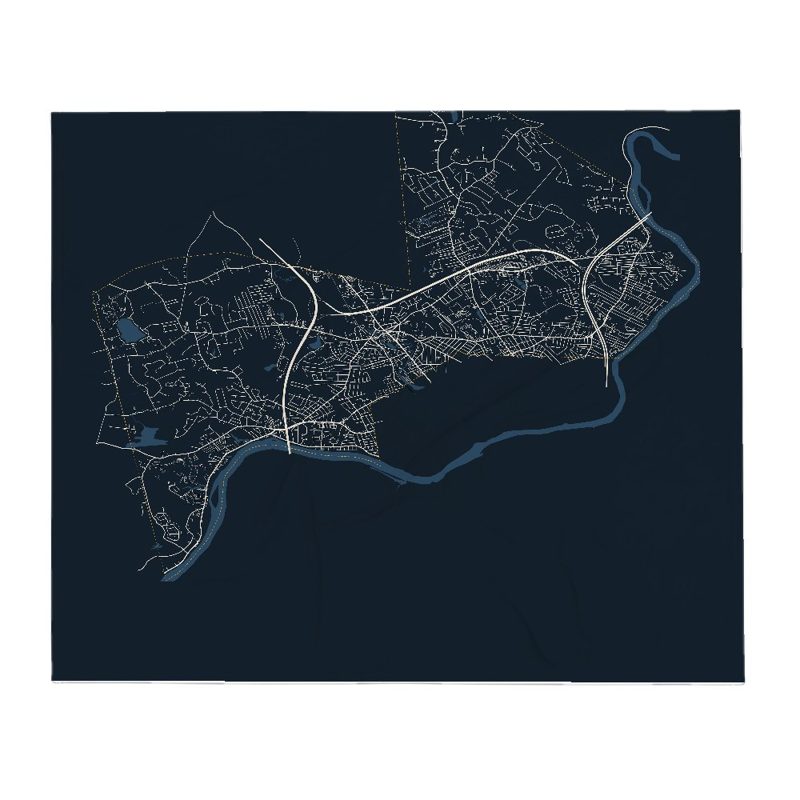
The same map, in navy and silver
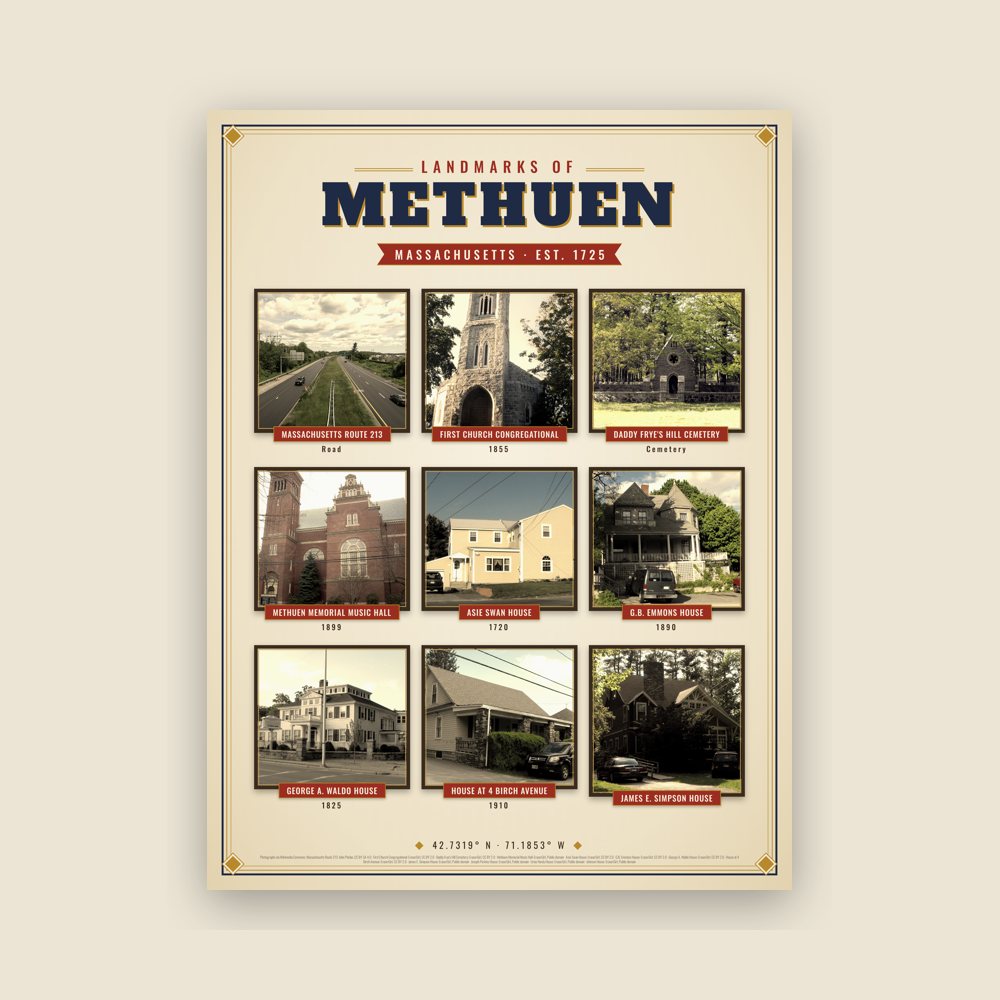
Nine local landmarks, archival matte
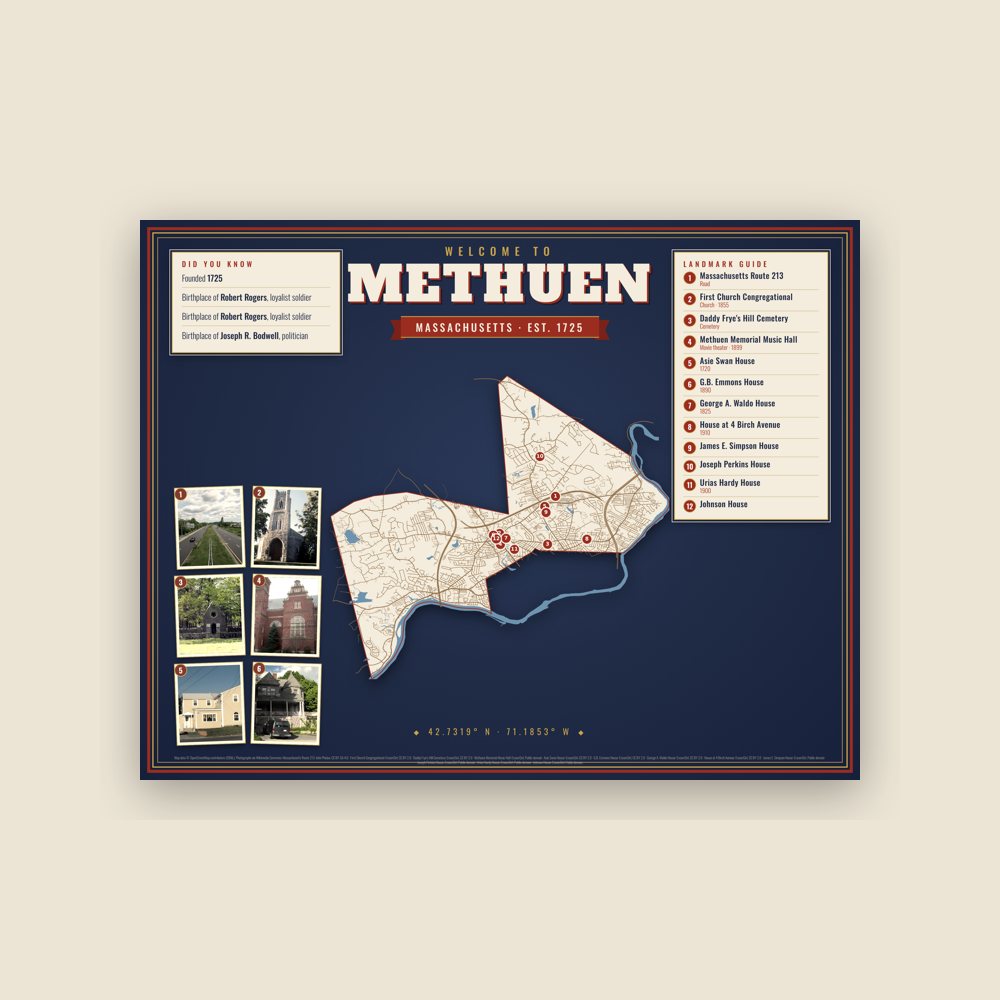
Map of local landmarks, washable fabric
Heavy-blend fleece, street map printed on the back
Soft Bella+Canvas jersey
Glossy ceramic, dishwasher safe
Ceramic keepsake, gold ribbon
Weatherproof, for the front walk
Soft-touch, zip cover
Sturdy all-over-print tote
Glossy top, cork back
Soft fleece, 50″×60″
20 oz, double-wall stainless
Population 2010: 47,255 → 2020: 53,059
From Wikidata (CC0).
Methuen was first settled in 1642 and was officially incorporated in 1726. Methuen was originally part of Haverhill, Massachusetts. In 1724 Stephen Barker and others in the western part of that town petitioned the General Court to grant them permission to form a new town above Hawke's Meadow Brook. Although opposed by their fellow townsmen, the petition was approved the following year (December 8, 1725), and the General Court gave them an act of incorporation under the name of Methuen. The town was named for Sir Paul Methuen, a member of the King's Privy Council and friend of acting Provincial Governor William Dummer. The first town meeting was held on March 9, 1726, in the home of a resident. The land was set aside for a meetinghouse, which was erected later in 1726 on what is now Meetinghouse Hill Cemetery.
The residents in the northern part of the new town of Methuen soon petitioned to have their own meetinghouse (a combination of town hall and puritan church), and in 1736 the north parish was set off. Land for a meetinghouse was donated by descendants of the original proprietors of Haverhill, and in 1738 the second Methuen meetinghouse was raised. The structure survives to this day, as the Salem N.H. Historical Society building. In 1741, with the fixing of the Northern boundary of Massachusetts, most of this new north parish was removed from Methuen and placed in New Hampshire. It was incorporated as Salem, New Hampshire in 1750.
Industrial growth in the 1800s influenced Methuen's development. Construction of the Methuen Cotton Mills at the Spicket River falls in the 1820s and the increased manufacture of hats and shoes in small factories along the Spicket spurred the centralization of Methuen's economic, residential and cultural activities within the area around Osgood, Broadway, Hampshire and Pleasant streets. Three wealthy and prominent families—the Nevins, the Tenneys and the Searles—played a significant role in Methuen's history and development. These families were instrumental in the founding of many of Methuen's landmarks, including the Nevins Memorial Library, the Searles building, Tenney Gatehouse, Nevins Home, Spicket Falls, and the Civil War monument between Pleasant and Charles streets.
In 1922, it was affected by the 1922 New England Textile Strike, shutting down the mills in the city over an attempted wage cut.
Adapted (trimmed) from the Wikipedia article Methuen, Massachusetts, revision 1378655452 by its contributors, licensed CC BY-SA 4.0.
We share a part of every Methuen sale with local partners, and we'd love to print from your collection. Old photographs, maps and postcards make the best keepsakes.
Partner with us