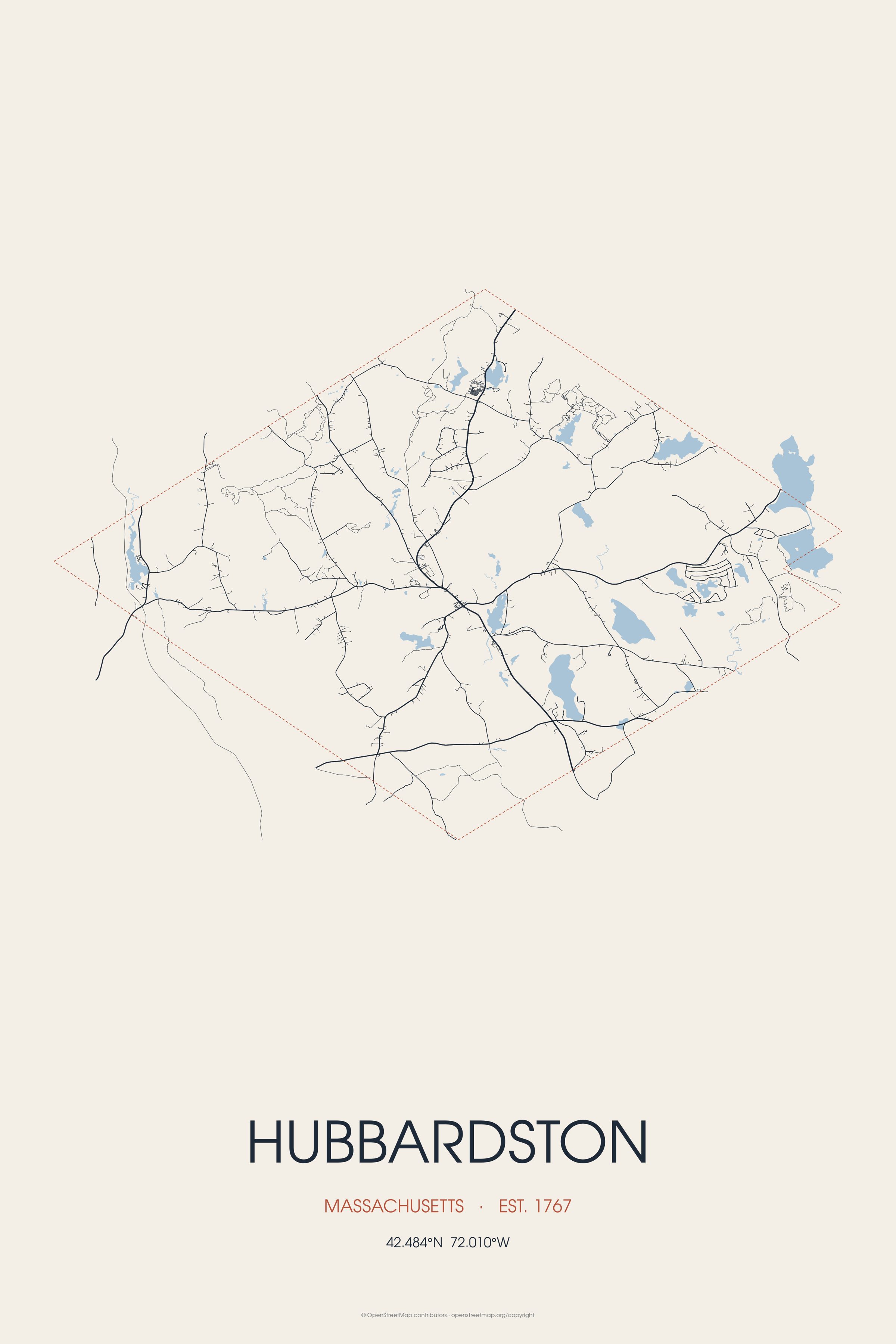
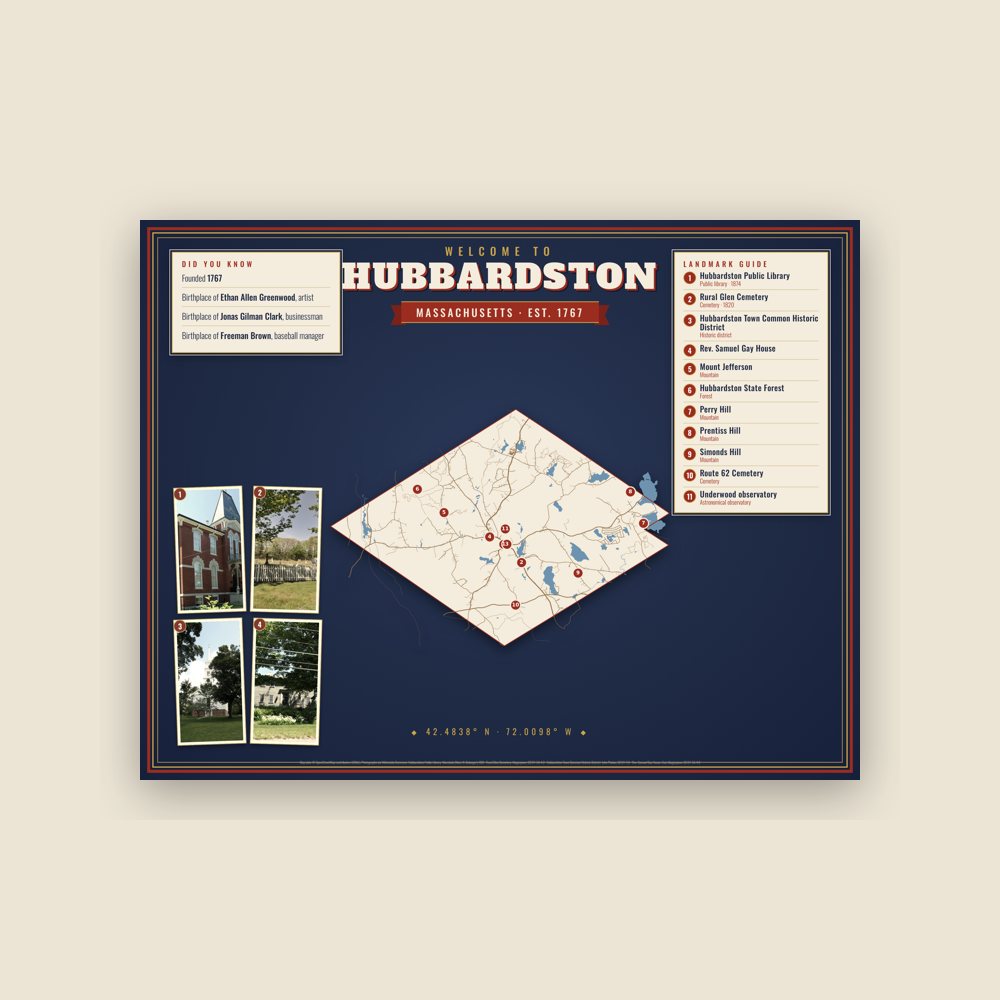
Hubbardston, the "Northeast Quarter" of Rutland, was incorporated as a separate district in 1767 and named for Thomas Hubbard (1702–1773), Commissary General of the Province of Massachusetts and Treasurer of Harvard College. Landmarks include Hubbardston Public Library, Rural Glen Cemetery and Hubbardston Town Common Historic District. Hubbardston is the birthplace of Ethan Allen Greenwood, artist.
Every piece is drawn from Hubbardston's own map data and historic archives, then printed and shipped from the USA when you order. No two towns look alike.
Every road in town, on archival matte paper
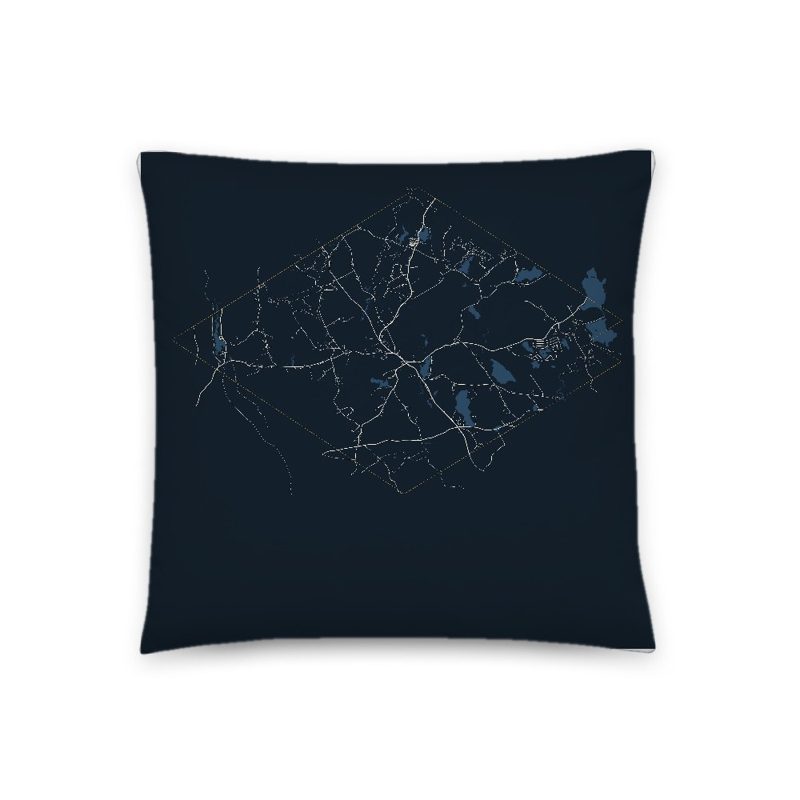
The same map, in navy and silver
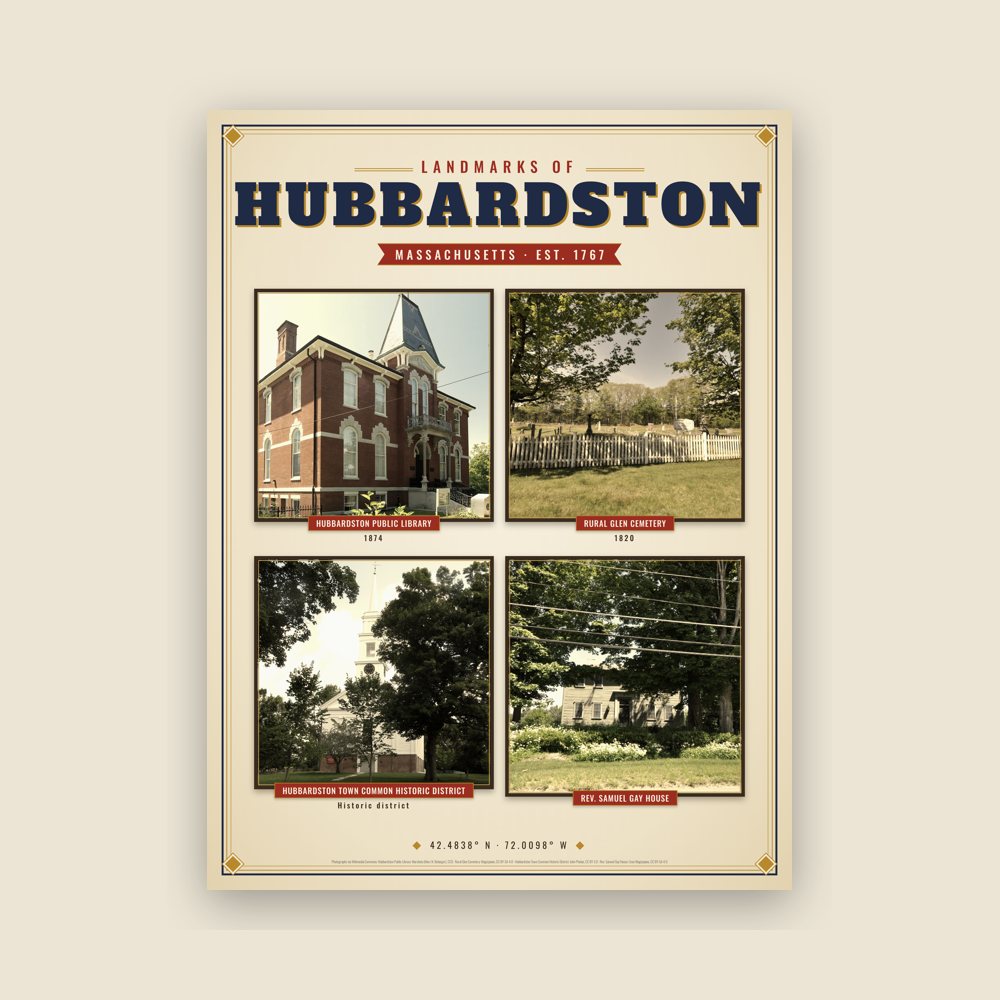
Nine local landmarks, archival matte
Map of local landmarks, washable fabric
Heavy-blend fleece, street map printed on the back
Soft Bella+Canvas jersey
Glossy ceramic, dishwasher safe
Ceramic keepsake, gold ribbon
Weatherproof, for the front walk
Soft-touch, zip cover
Sturdy all-over-print tote
Glossy top, cork back
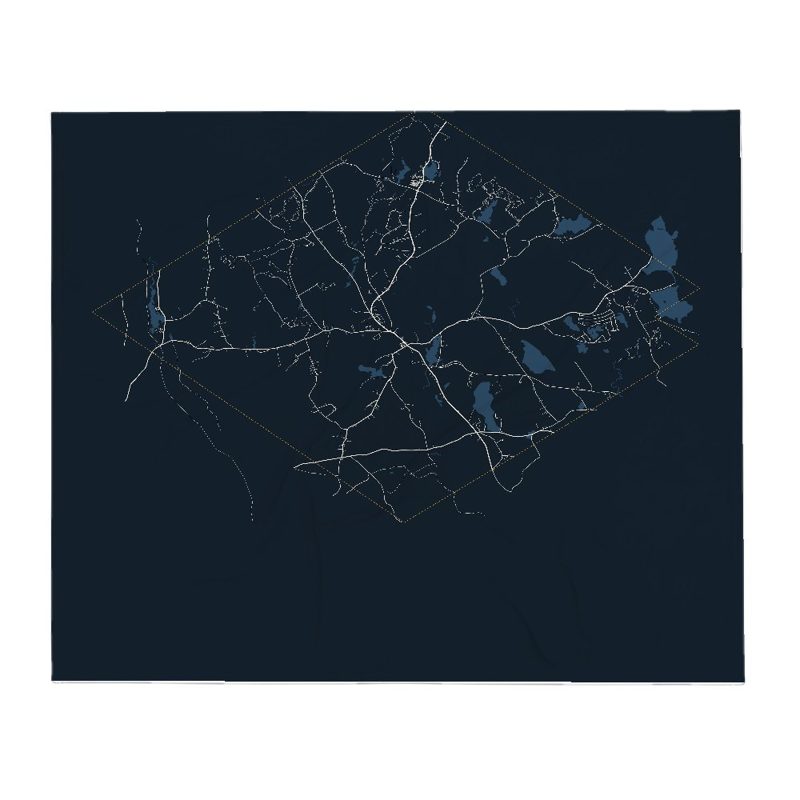
Soft fleece, 50″×60″
20 oz, double-wall stainless
Population 2010: 4,382 → 2020: 4,328
From Wikidata (CC0).
Hubbardston, the "Northeast Quarter" of Rutland, was incorporated as a separate district in 1767 and named for Thomas Hubbard (1702–1773), Commissary General of the Province of Massachusetts and Treasurer of Harvard College. It is reported in local history that in view of the honor of giving his name to the town, Hubbard promised to provide the glass for the windows of the first meeting house built in town. To make his liberality more conspicuous, the people planned for extra windows, but when Hubbard died in 1773, his estate was so complicated that the town of Hubbardston received nothing and was obliged to glaze the windows at its own expense.
In 1737 Eleazer Brown located on a farm of 60 acres given him by the proprietors of Rutland on the condition that he operate a public house or inn. Until 1746, Brown and his wife were the only inhabitants of Hubbardston. After Eleazer's death (reportedly killed by a deer), Mrs. Brown was then the only occupant of town for several years, and she kept the public house for prominent travelers. In 1749, Israel Green moved into Hubbardston. His daughter, Molly Green, is reported to be the first child born in Hubbardston. Mr. Green was the first chairman of the board of selectmen.
The town's early economy was based on agriculture and small-scale chair, boot, and shoe manufacturing. It is described by historians as a poor town, sparsely settled and almost wholly agricultural, but having sawmills, potash works, and cottage industries such as the making of palm-leaf hats. By the 19th century, dairy and berry farming and market gardening were major pursuits in the town. Immigrants from Ireland, French Canada, England, Sweden, and Finland moved to town to work on local farms.
Captain Adam Wheeler, one of the leaders of Shays' Rebellion, an armed uprising in central and western Massachusetts, was from Hubbardston. In 1786, eighty men from the town marched to Worcester under Wheeler's command and, joining hundreds of other farmers, took control of the courthouse to protest the widespread foreclosures and seizures of property by creditors that occurred during the cash-poor 18th century.
Hubbardston is home to the invention of the first backhoe swing frame, developed in July 1947 by Vaino J. Holopainen (pronounced "Waino") and Roy E. Handy, Jr., (thus the company name "Wain-Roy") and assigned to Wain-Roy Corporation of Hubbardston. In July 1948, patent # 2,698,697 was filed by Vaino J. Holopainen.
Adapted (trimmed) from the Wikipedia article Hubbardston, Massachusetts, revision 1377385449 by its contributors, licensed CC BY-SA 4.0.
We share a part of every Hubbardston sale with local partners, and we'd love to print from your collection. Old photographs, maps and postcards make the best keepsakes.
Partner with us