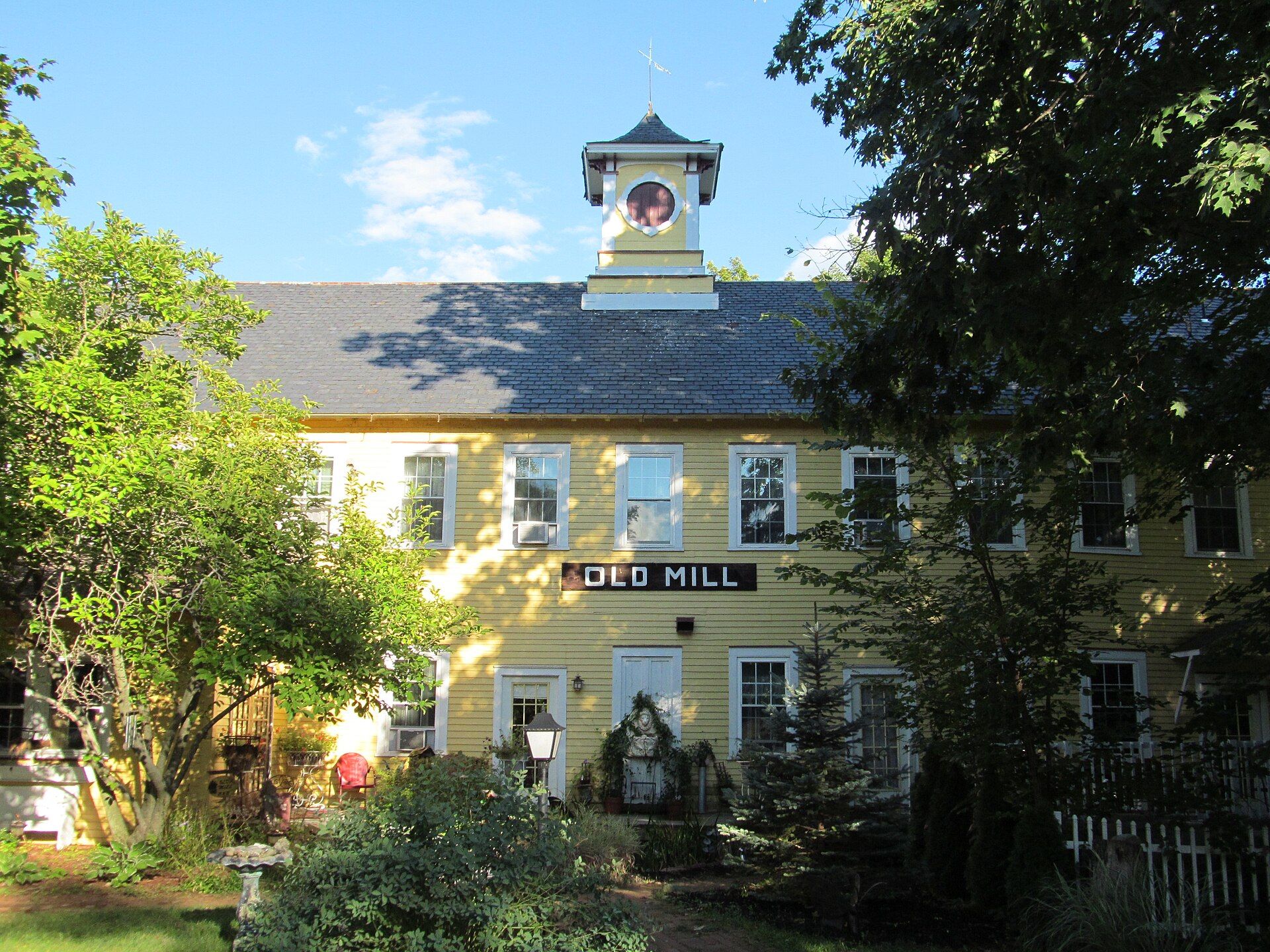
Hatfield was founded in 1660 on land granted to General Daniel Dennison and Governor William Bradford. Landmarks include Old Mill Site Historic District, Holy Trinity Parish, Hatfield and Mill-Prospect Street Historic District. Hatfield is the birthplace of Rodolphus Dickinson, politician.
Every piece is drawn from Hatfield's own map data and historic archives, then printed and shipped from the USA when you order. No two towns look alike.
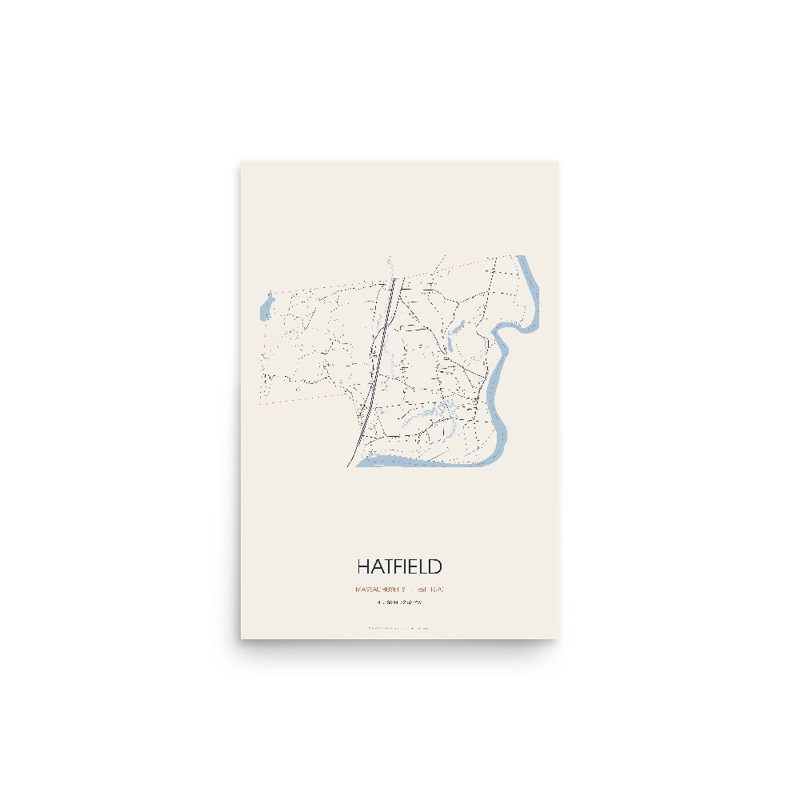
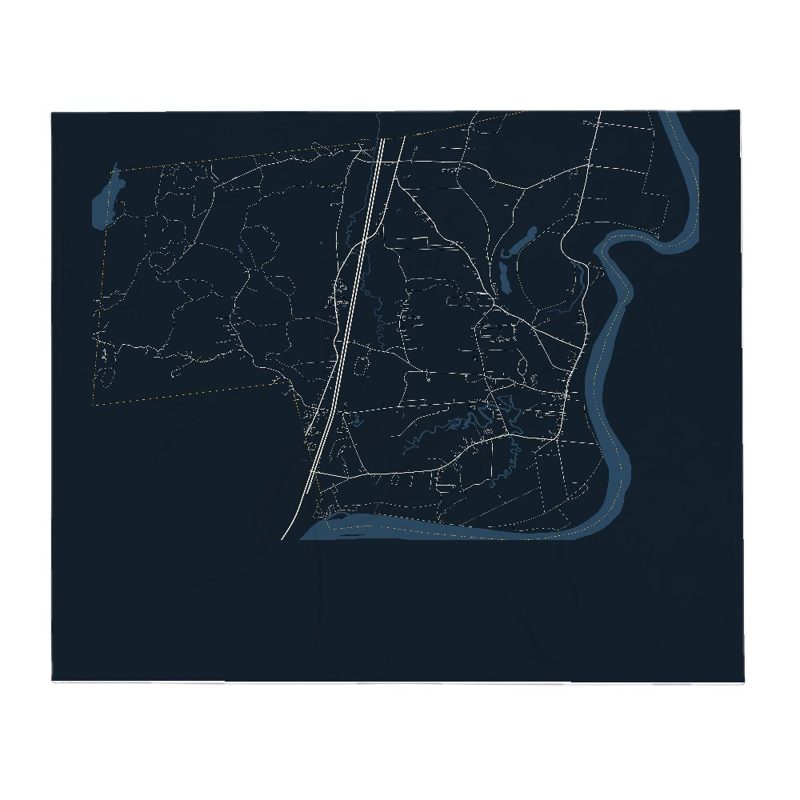
Every road in town, on archival matte paper
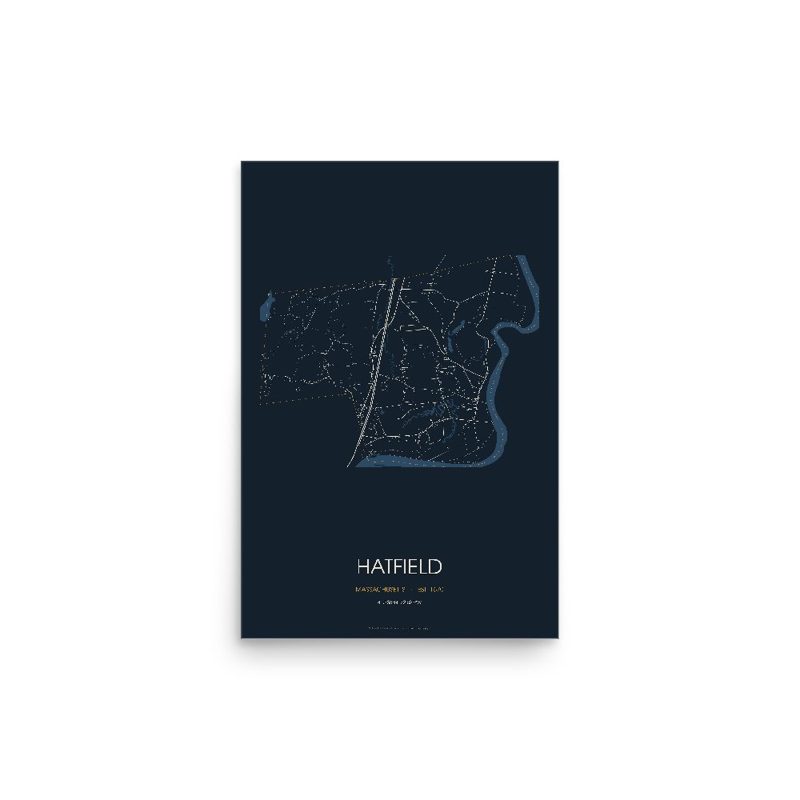
The same map, in navy and silver
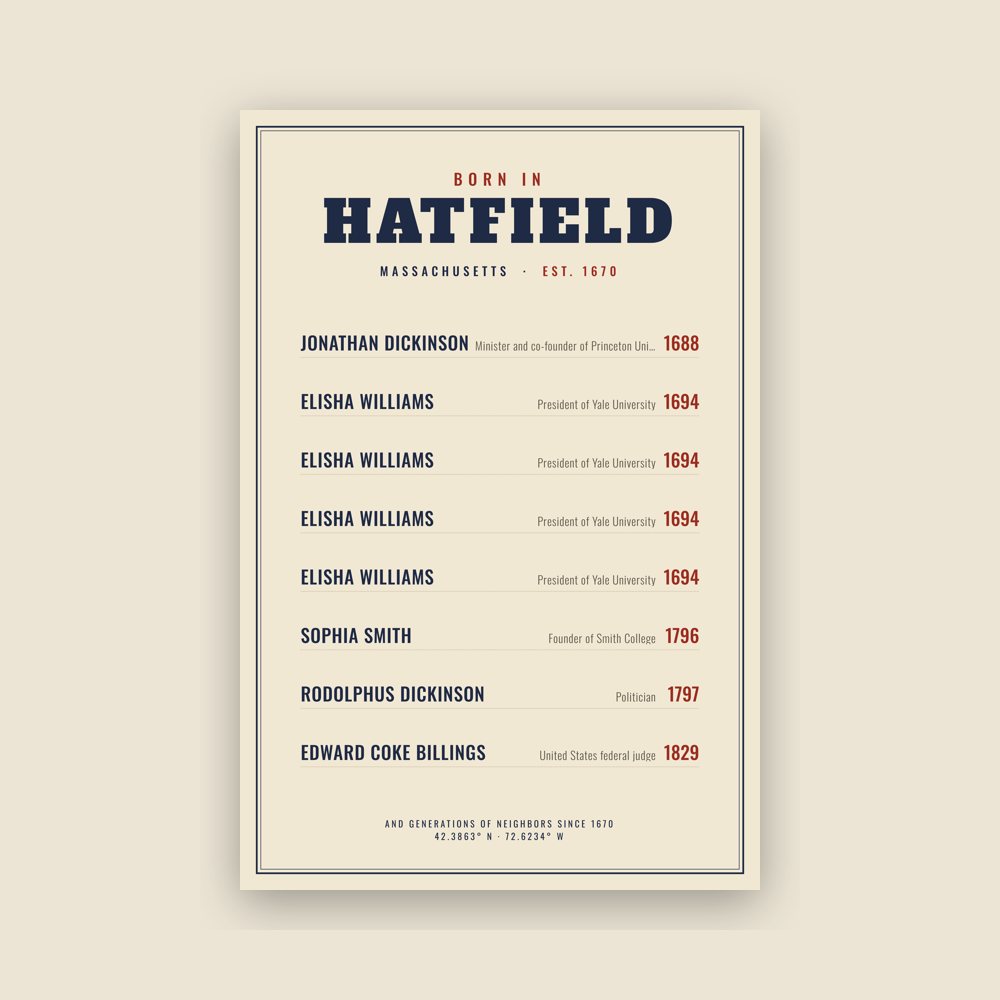
Famous natives, by birth year
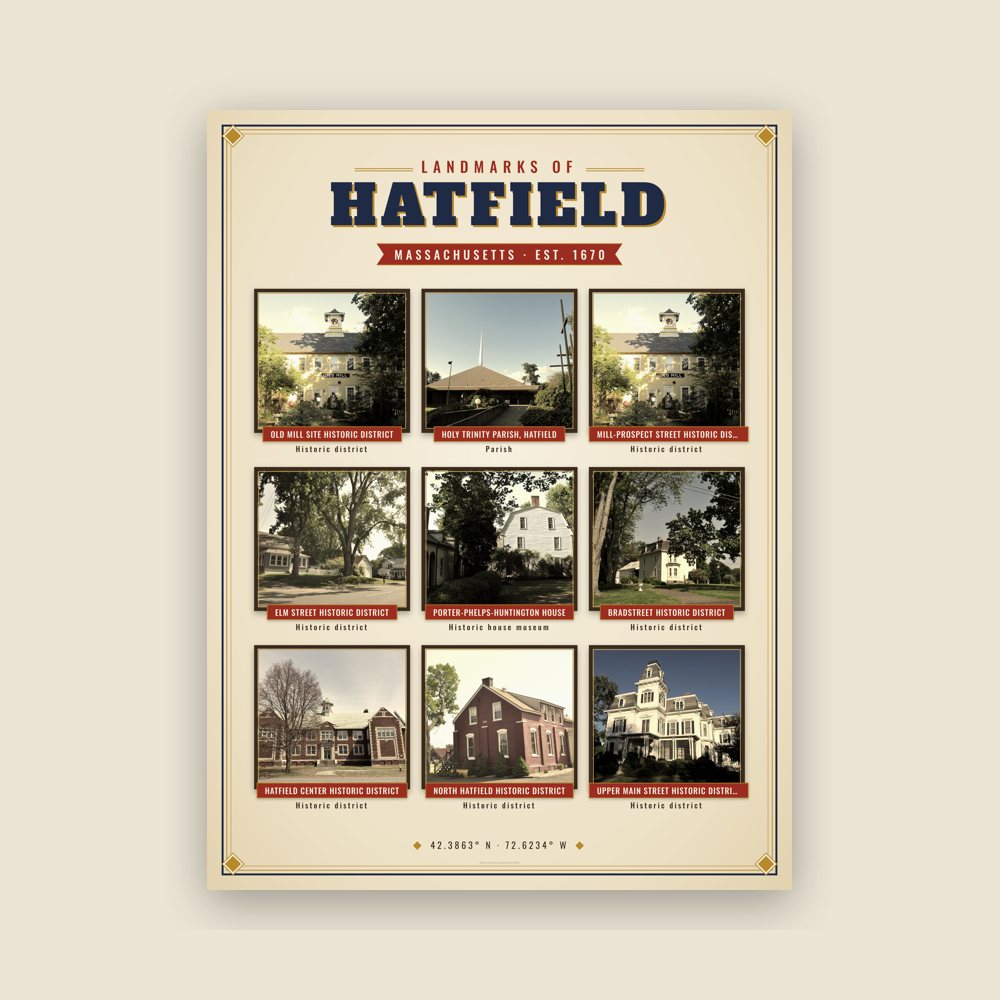
Nine local landmarks, archival matte
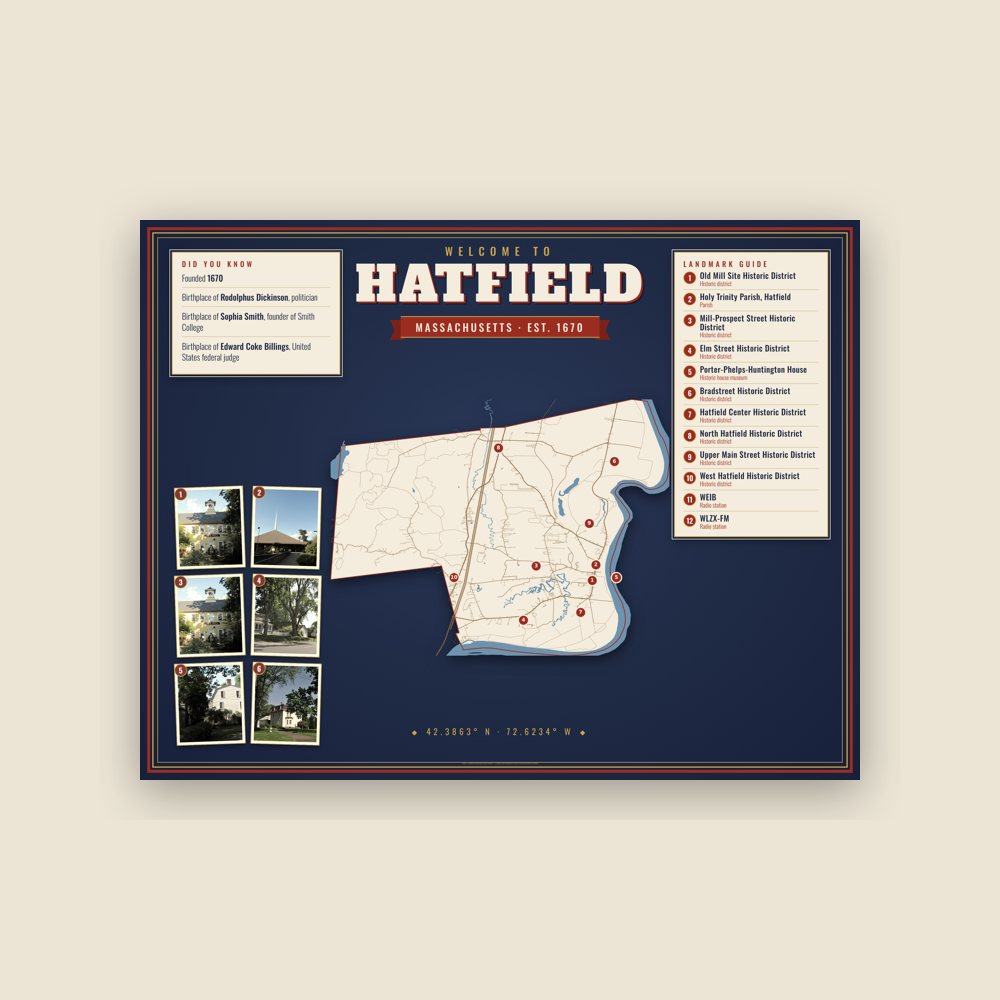
Map of local landmarks, washable fabric
Heavy-blend fleece, street map printed on the back
Soft Bella+Canvas jersey
Glossy ceramic, dishwasher safe
Ceramic keepsake, gold ribbon
Weatherproof, for the front walk
Soft-touch, zip cover
Sturdy all-over-print tote
Glossy top, cork back
Soft fleece, 50″×60″
20 oz, double-wall stainless
Population 2010: 3,279 → 2020: 3,352
From Wikidata (CC0).
Hatfield was founded in 1660 on land granted to General Daniel Dennison and Governor William Bradford. It was formally incorporated as a town in 1670 and has a board of selectmen and an annual town meeting.
During the late 1650s, the church in Hartford fell into a bitter dispute over the "Half Way Covenant," a newly-adopted Puritan policy surrounding granting partial membership to children of non or partial members.
A group of strict-constructionist Puritans decided to break away entirely. Between 1659 and 1661, they packed up and moved north, initially settling on the east side of the Connecticut River in Hadley. However, the dispute crossed the river with them, and thus roughly two dozen families crossed to the west side of the river.
One of the theories of Hatfield's incorporation in 1670 was that during that time it was a colony of Hadley and Hadley's church was located across the Connecticut River on what is now West Street in present-day Hadley. The citizens living in what is now Hatfield asked the officials if they could build the church on the west side of the river, so that they could go to church and not have to cross the river, which was hard to cross every week, especially during the winter season when the river would freeze. When the citizens asked main Hadley, Hadley said "No." Enraged, they held a vote on whether Hatfield would still remain territory of Hadley, or secede into its own town. The vote for secession won. Many believed this was a good decision as during that time, travel was not easy, and it was very unusual for the already large Hadley, which had already claimed many of its surrounding towns, to have a spot on the west side of the river.
As a center for agriculture, the region produced cattle, sheep, corn, and tobacco. At first their relations with the local Native Americans were very welcoming on both sides. On October 16, 1675, a substantial part of the town was destroyed in the Raid on Hatfield during King Philip's War, and surviving settlers sought refuge in Springfield. On September 19, 1677, another raid occurred, killing thirteen and resulting in seventeen hostages being taken to Canada. After nine months, the surviving hostages were ransomed and returned to Hatfield.
During the American Revolution, Hatfield was an important source of supplies and men for the rebels. In 1786, the town was used as an assembly area for the discontented who became involved in Shays' Rebellion.
One family supplied many of Hatfield's physicians for generations. The Hastings family, descendants of English Puritan immigrant Thomas Hastings, was originally settled at Watertown, but within a generation members of the family had relocated to Hatfield, where they produced a succession of Hatfield physicians, including Dr. Thomas Hastings (1652–1712); Dr. Thomas Hastings (1679–1728); Dr. Waitstill Hastings (1714–1748); and Dr. John Hastings (1765–1845). The first Thomas Hastings, aside from serving as physician to Hatfield and surrounding communities, was also the town's first schoolteacher. He authored a contemporary account of the devastating 1704 Indian attack on nearby Deerfield.
Hatfield was the birthplace and hometown of Sophia Smith (1796–1870), the founder of both Smith Academy (the Hatfield public high school), and Smith College, the famous women's college in Northampton. Another notable resident was Rebecca Dickinson (1738–1812), a never-married gownmaker whose surviving diary, preserved in the collections of the Pocumtuck Valley Memorial Association in Deerfield, has served as the basis for scholarship in early American women's history.
Adapted (trimmed) from the Wikipedia article Hatfield, Massachusetts, revision 1380270743 by its contributors, licensed CC BY-SA 4.0.
We share a part of every Hatfield sale with local partners, and we'd love to print from your collection. Old photographs, maps and postcards make the best keepsakes.
Partner with us